Coming soon 7:38 Recorded at AGNTCon + MCPCon North America, San Jose
What changes when an agent leaves the demo for production?
Agents in production, at the edge
Agents from demo to production, with Akamai Cloud's Lena Hall: latency, where the data lives, open-weight models, and functions with no cold start.
Lena Hall, Senior Director of Developer Relations, Akamai · with  Luca Berton
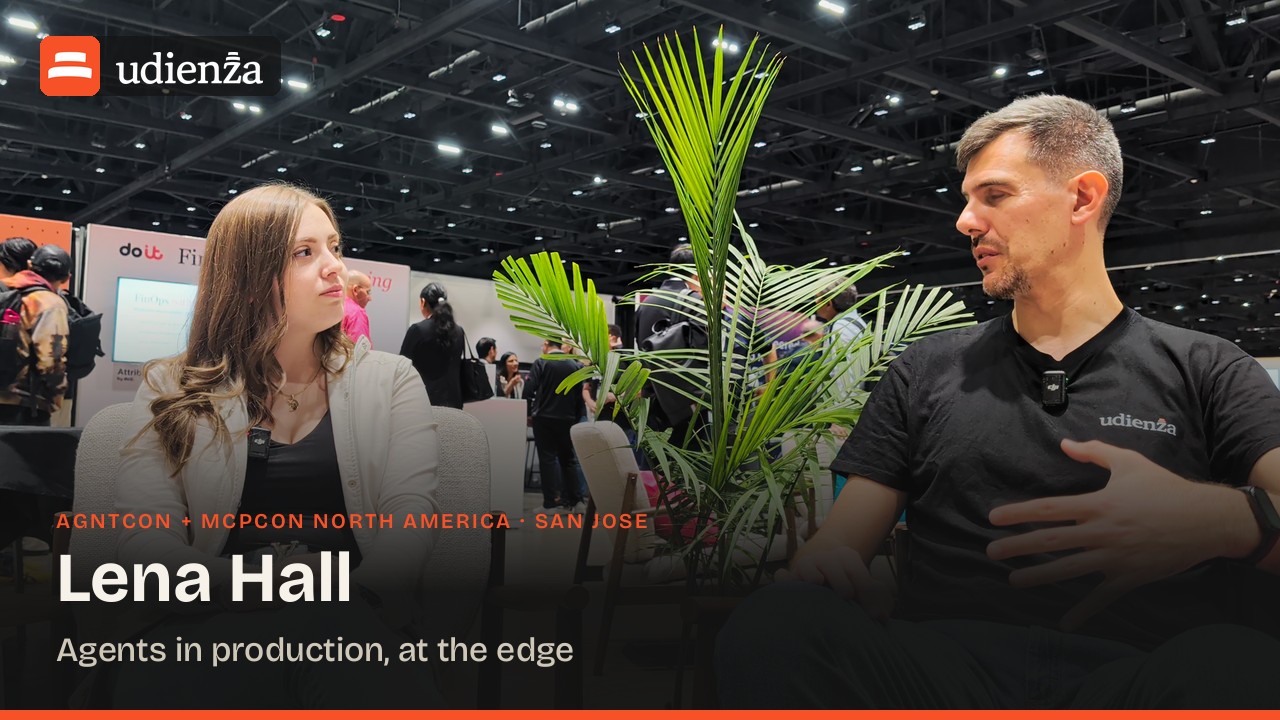
Not filmed yet.
At Akamai, Lena Hall is Senior Director of Developer Relations and leads that work for Akamai Cloud.
Follow the show and the episode arrives the morning it's published.
In brief
- Akamai Cloud's distributed infrastructure is meant to give developers a fast, effective and secure environment for the more complicated things they now build with agents.
- Autonomous operations are among the biggest use cases she sees, in retail, banking and health care: personalized recommendations, and a shorter path from exploration to purchase.
- A demo on a frontier model forgives downtime and slow answers; production has to account for scale, security, distribution and latency.
- In a voice agent the delay is what people notice: if the speech lags, they cancel the call.
- Control means locality: some data cannot leave a place, and a request should be routed to the model and compute closest to the user.
- Open-weight models can be deployed and fine-tuned on Akamai Cloud's NVIDIA GPUs, Blackwell among them, so customers keep control of location, data and latency.
- Its serverless functions run on Spin, a CNCF project built on WASM, so there are no cold starts.
- Her advice: start from a quick start or a workshop, build something real with a coding agent, keep production's constraints in mind, and sandbox agents that can do dangerous things.
Chapters
- 0:00 Developer relations at Akamai Cloud
- 0:51 Autonomous ops and personalization
- 1:44 From demo to production
- 3:03 Latency, locality and control
- 4:28 GPUs and open-weight models
- 5:18 Functions without cold starts
- 6:12 Getting started, and security
Why this conversation
An agent that answers well in a demo can still let down the people it is built for. Lena Hall, Senior Director of Developer Relations at Akamai, leads developer relations for Akamai Cloud. In this conversation she took on that gap: what an agent needs once it is out of the demo, from a lag a caller can hear to data that may not travel. The host recorded with her in San Jose on 22 October 2026, the first day of AGNTCon + MCPCon North America. The rest of that day is in AGNTCon + MCPCon North America 2026: day one.
More powerful agents, more complicated systems
The host opened with agentic AI, which he called huge right now. Lena’s view is that developers have been working with AI for quite a few years, and as agents grow more powerful, the solutions people build with them grow more complicated. Akamai Cloud brings distributed infrastructure to that work, so that the environment it runs in is quick, effective and secure.
Asked for the biggest use case she has seen, she pointed to autonomous operations, in industries such as retail, banking and health care. Personalization is her example. Someone shopping meets an agent that suggests products based on their history and preferences, and spends less time picking and selecting. The business gains as well: it runs more efficiently, and the time between browsing and buying shrinks.
Leaving the demo behind
How does a prototype become a production system? She called it an age-long question. Plenty of demos, she says, are a Hello World agent running on a frontier LLM from a centralized provider, and for simple scenarios that is fine. “For a demo, you can forgive certain things.” Nobody worries about downtime, or whether each step completes in a given number of milliseconds; a demo, the host agreed, is where you take a shortcut. In production, scale, security, distribution and latency all have to be handled, in the way that matters to the customers.
Her example is a customer support agent that speaks to people through a multimodal API with voice. If its speech lags, callers give up and hit cancel, and the product loses them. The agent has to work at a speed and a price the business can keep up.
That is why many customers Akamai works with ask for more control over their own infrastructure once in production. To her, control means locality. Some data must stay where it is: a robot in a warehouse that holds unreleased products cannot send that data out of a certain geography or a confined environment. And a request coming from one place should go to the model and the compute nearest the user, for the best latency and routing. Open-weight models allow both, because they can be fine-tuned and optimized for a specific location while the data stays local. That, the host said, is especially important in Europe, with its big debate on data sovereignty.
What runs on Akamai Cloud
Access to GPUs is difficult right now, she says, and Akamai provides AI infrastructure on NVIDIA-powered GPUs, Blackwells among them, on which to build agents and run inference. Customers can deploy open-weight models there and fine-tune them. “So you retain control over your location, over your data, over your latency.”
There are serverless functions too. She compared them to AWS Lambda, where cold starts are a familiar problem: the first request takes far longer to begin. Akamai’s functions are built on Spin, a CNCF project that is itself based on WASM, and that does away with the cold start. A function can be triggered and its compute started at once, and if the model is also routed by where the user is, latency improves a great deal.
Getting started, safely
Her starting point is the Akamai Developers organization on GitHub, where there are workshops on AI inference, on deploying and optimizing open-weight models, and on routing requests correctly. Akamai also runs a Discord community called the Edge Case, about LLMs, serverless and cloud computing, with live coding in its shows.
Her advice: take a quick start or finish a workshop, find a real use case from your personal life, and implement it together with a coding agent, while keeping in mind the production constraints you will hit as you scale. And think about security: an agent can carry out dangerous operations, so she recommends sandboxing and safe environments.
When it comes out
The episode is edited and in the release order. Like every episode it goes out on YouTube first, then on Apple Podcasts, Spotify and Amazon Music.
Mentioned in this episode
About Lena Hall
At Akamai, Lena Hall is Senior Director of Developer Relations and leads that work for Akamai Cloud.
Running this in production? Luca Berton helps platform teams take it from prototype to reliable production. See how he works
Built something the rest of us run on? Being a guest is free. Take the other chair
More episodes
All episodes →-
Episode 62 · Coming
Siddarth Shekhar: A first con in Silicon Valley
-
Episode 64 · Coming
Daniel Hoang: Argo CD and Akuity
-
Episode 71 · Coming
Jacek Migdał: What agentic coding is really worth
-
Episode 61 · Coming
Alec Reynolds: Docs written by agents