Coming soon 3:51 Recorded at AGNTCon + MCPCon North America, San Jose
What does GitOps look like when people would rather prompt an AI?
Argo CD and Akuity
Daniel Hoang of Akuity, whose team built Argo CD, on Kargo, GitOps pipelines with the steps built in, and an MCP layer to build and debug them with AI.
Daniel Hoang, DevOps Sales Engineer, Akuity · with  Luca Berton
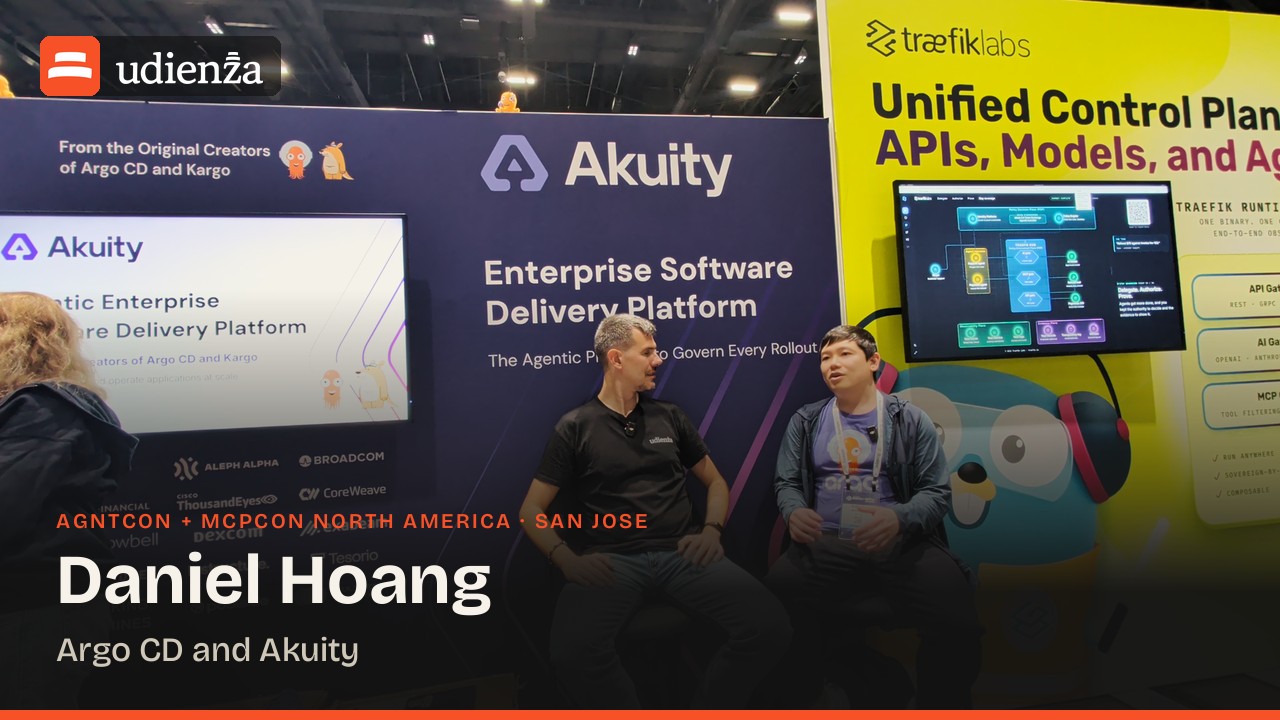
Not filmed yet.
Daniel Hoang is a DevOps Sales Engineer at Akuity, the company whose team built Argo CD.
Follow the show and the episode arrives the morning it's published.
In brief
- When Kubernetes was new, teams scripted their own deployments, and nothing helped them see what was running or what had gone wrong.
- Argo CD, built by the team behind Akuity, brought a GitOps developer experience: what is deployed where, and remediation when something goes wrong.
- Implementing Argo CD still means scripting; Kargo has the steps built in, a UI of what is deployed where, and gates between environments.
- Many people now prefer AI as their front end, so Akuity built an agentic control plane layer on MCP that gates the agent's permissions.
- From an assistant such as Claude or Copilot, a user can ask for a Kargo pipeline that follows best practice, or for the applications degraded across every environment.
- Argo CD and Kargo are open source; the MCP and agent layers are part of Akuity Enterprise, with a trial.
Why this conversation
A good tool still has to be adopted, and someone still has to build the pipelines it runs. Daniel Hoang works at Akuity, the company whose team built Argo CD, and in this conversation he traced the path from the early days of deploying on Kubernetes to an assistant that builds a delivery pipeline on request. The host recorded with him in San Jose on 22 October 2026, the first day of AGNTCon + MCPCon North America, and asked him to begin with Argo CD and Akuity. The rest of that day is in AGNTCon + MCPCon North America 2026: day one.
Where Argo CD came from
Daniel started with history. Argo CD arrived when people were trying to work out how to deploy better on Kubernetes, at scale and for multiple teams. When Kubernetes was first coming out, there were few standardized ways to do that, so people wrote scripts to deploy. What those scripts did not give them was any help when something went wrong, or a clear view of what was going on.
The team behind Akuity is the team that built Argo CD, at a time when, as he puts it, they were reshaping how to do Kubernetes. Their tool led the way with a developer experience built on GitOps. People could understand how their applications had been deployed to Kubernetes, what that looked like, and what had shipped to their real environments. And if something went wrong, Argo CD was able to remediate those changes.
Kargo: the steps built in
That is not where the story ends. Today, Daniel says, implementing Argo CD can be very challenging, because the whole process still has to be scripted. Akuity built a tool to bridge the gap in the middle: Kargo. Rather than scripted solutions to update GitOps pipelines, it comes with every step already built in. It provides a UI so that people can see what is deployed where, and it lets a team gate deployments between its various environments. The host found it fantastic, especially in a world this fast-paced.
AI as the front end
Then the host asked how Akuity supports AI workloads. Daniel’s answer explained why the company was at AGNTCon + MCPCon at all. Even tools that offer a good experience raise a further question: how do you get users to adopt them, and how do people build these pipelines on their own? That can be very hard. “Today, a lot of people prefer to use AI as their front-end experience.” They simply prompt Claude and ask it to build things.
So Akuity has built what Daniel calls an agentic control plane layer, part of MCP, that gates the permission set so that people can adopt the tool. Once the MCP tool is connected to an assistant such as Claude or Copilot, a user can ask for a Kargo pipeline built to best practice from what already sits in their Git repositories. Troubleshooting works the same way: ask which applications are degraded across all of your environments, and the answer points to the root cause in each of them. The host summed it up as dev, staging and production together, and Daniel agreed.
Open source, then Enterprise
How can someone give it a go? Both Argo CD and Kargo are open source, so they can be tried for free, in pure open source. To go further, into layers such as MCP and agents, means Akuity Enterprise: a conversation with the team, and a trial to test it out.
The host proposed building more GitOps together, and wondered what to call all this. AI GitOps, perhaps? Daniel offered a different name: “Software delivery with Akuity.”
When it comes out
The episode is edited and in the release order. Like every episode it goes out on YouTube first, then on Apple Podcasts, Spotify and Amazon Music.
Mentioned in this episode
About Daniel Hoang
Daniel Hoang is a DevOps Sales Engineer at Akuity, the company whose team built Argo CD.
Running this in production? Luca Berton helps platform teams take it from prototype to reliable production. See how he works
Built something the rest of us run on? Being a guest is free. Take the other chair
More episodes
All episodes →-
Episode 63 · Coming
Lena Hall: Agents in production, at the edge
-
Episode 65 · Coming
Rania Khalaf: AI governance at WSO2
-
Episode 30 · Coming
Sudeep Goswami: Runtime governance for AI agents
-
Episode 09 · Coming
Shannon Williams: When enterprises trust agents