Coming soon 4:51 Recorded at Dutch Cloud Native Day 2026, Utrecht
Why would a team swap Sentry for a European error tracker?
Klaas van Schelven: Bugsink, a European Sentry
Klaas van Schelven, founder of Bugsink, on error tracking as the European alternative to Sentry: one line to switch, data in Europe, simpler and cheaper.
Klaas van Schelven, Founder,  Bugsink · with
 Luca Berton
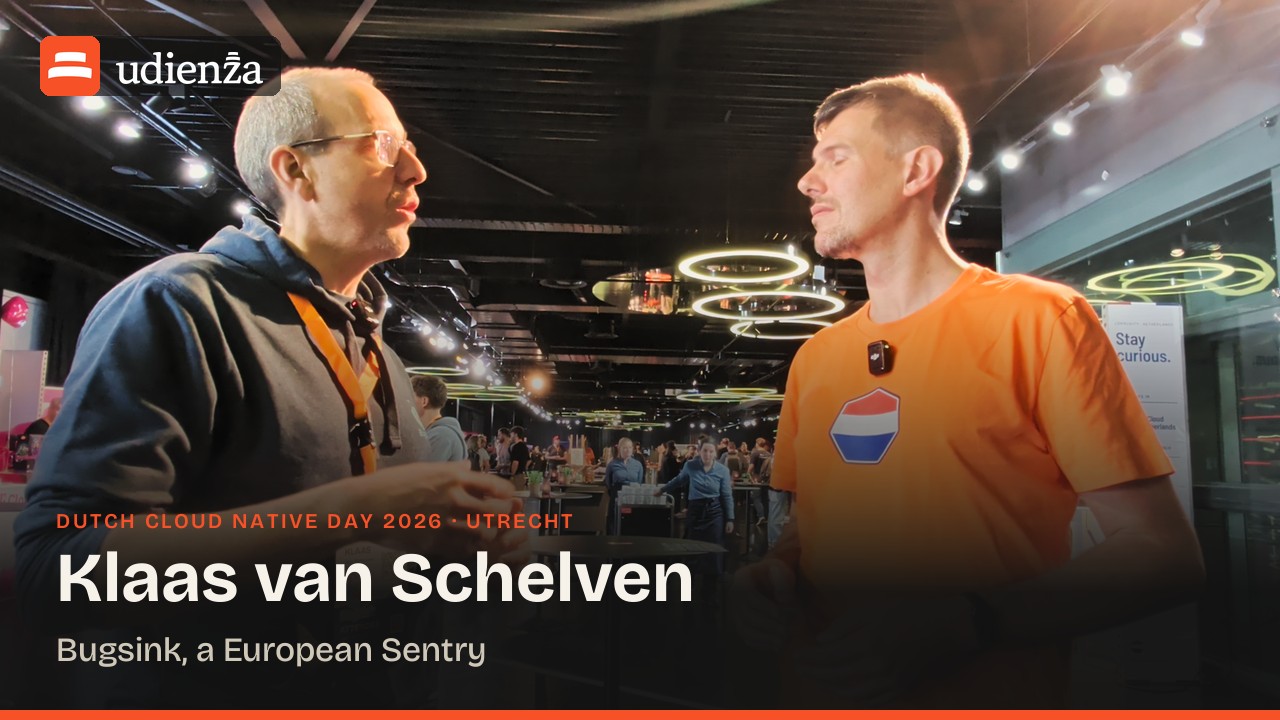
Recorded, coming soon.
Klaas van Schelven is the founder and developer of Bugsink, an error tracking solution from the Netherlands.
Follow the show and the episode arrives the morning it's published.
In brief
- Error tracking collects the errors of software in production in one place, alerts you, and gives enough to solve them, or to have your agent solve them.
- The pitch: know before your phone goes, not when a user calls to say everything is broken.
- Bugsink is compatible with Sentry's client libraries: switch one line, the DSN.
- Many customers like Sentry but want their data to stay in Europe, with a European company.
- It is much simpler: just the errors, in a clean interface.
- It is much cheaper, so the error volume is more likely to last to the end of the month.
Chapters
- 0:00 Error tracking, the European Sentry
- 1:00 Know before your phone goes
- 1:31 One line to switch from Sentry
- 1:53 Data that stays in Europe
- 2:33 Simpler: just the errors
- 3:05 Cheaper, to the end of the month
- 4:14 Getting started: bugsink.com
Why this conversation
When software breaks in production, someone finds out first: ideally the team, not the user. Klaas van Schelven is the founder of Bugsink, an error tracking solution. The host recorded with him on 30 October 2026 at Dutch Cloud Native Day, at the Jaarbeurs in Utrecht.
Error tracking, the European Sentry
“So, Bugsink is an error tracking solution. So, depending on where you are, it is the European alternative to Sentry”. Error tracking, he explained, “is when you have software running in production and you have errors and you just collect all those errors, send them to a central place, get alerted about it and have enough information about it to solve it or to have your agent solve it.”
Know before your phone goes
Who notices first? “Typically, the users are noticing it and the developers are asleep and they’re not noticing it.” “You don’t want your user to call you and tell you everything’s broken. You want to be on top of stuff yourself, so you get to alert yourself when something breaks.”
One line to switch
“So, Sentry is definitely the market leader in this market of error tracking.” Bugsink is the same where it matters for adoption: “It’s completely compatible.” Sentry has many, many client libraries, and you keep them: “if you just switch the one line, which is called the DSN, you switch it out. And then you can just use Bugsink instead.”
Data that stays in Europe
The second reason is that it is European. Many customers like Sentry, or something like it, “But they want their data not to go to San Francisco and the NSA or they have compliance demands. And they just want their data to stay in Europe in an actual European country. Sorry, a European company, rather.”
Simpler: just the errors
“The third thing is, it’s much simpler.” “Like, any successful software tends to accumulate more and more stuff.” Customers tell him they got tired of Sentry getting bigger and more bloated. “We just want to track our errors.” When they open the page, “we want to see errors, we want to get a clean interface, and that’s it.” “And that’s definitely a reason people choose for us.”
Cheaper, to the end of the month
“And then there’s the kind of boring, but for many people, not so boring reason, which is that it’s much cheaper.” There are two sides to that: you spend less money, or you get more for the same amount, which in error tracking means more volume of errors. Paying by volume means working to keep the error count down to stay within the subscription, “which is annoying, right?” Something goes wrong and all of a sudden there are 10,000 errors; with an error every second, 100,000 errors gets you through the day, “But that’s not very far into your month.” Cheaper means you are more likely to make it to the end of the month. “So it’s cheaper, European-based, and library-compatible”, the host summed up.
Getting started
The site is bugsink.com: “So that’s a bug, like the thing you have in your software, and a sink, which is the opposite of a source, right?” Install it, “super easy”, or just sign up.
When it comes out
The episode is edited and in the release order. Like every episode it goes out on YouTube first, then on Apple Podcasts, Spotify and Amazon Music.
Mentioned in this episode
About Klaas van Schelven
Klaas van Schelven is the founder and developer of Bugsink, an error tracking solution from the Netherlands.
Running this in production? Luca Berton helps platform teams take it from prototype to reliable production. See how he works
Built something the rest of us run on? Being a guest is free. Take the other chair
More episodes
All episodes →-
Episode 99 · Coming
Paola Pimazzoni: Kubermatic, from the defense side
-
Episode 101 · Coming
Pieter Lewyllie: The Cloud Native Belgium meetup
-
Episode 102 · Coming
Benoit Schipper: OpenCommit, a forge in Europe
-
Episode 103 · Coming
Frank Stavenuiter: T Cloud, a European hyperscaler