Coming soon 7:39 Recorded at AGNTCon + MCPCon North America, San Jose
What do an MCP server's logs miss when an agent gives up?
Catching the silent failures of MCP servers
Kashish Hora of AgentCat on the silent failures MCP servers' logs never show, a one-line SDK that lets agents report back, and the agent experience.
Kashish Hora, Co-founder, AgentCat · with  Luca Berton
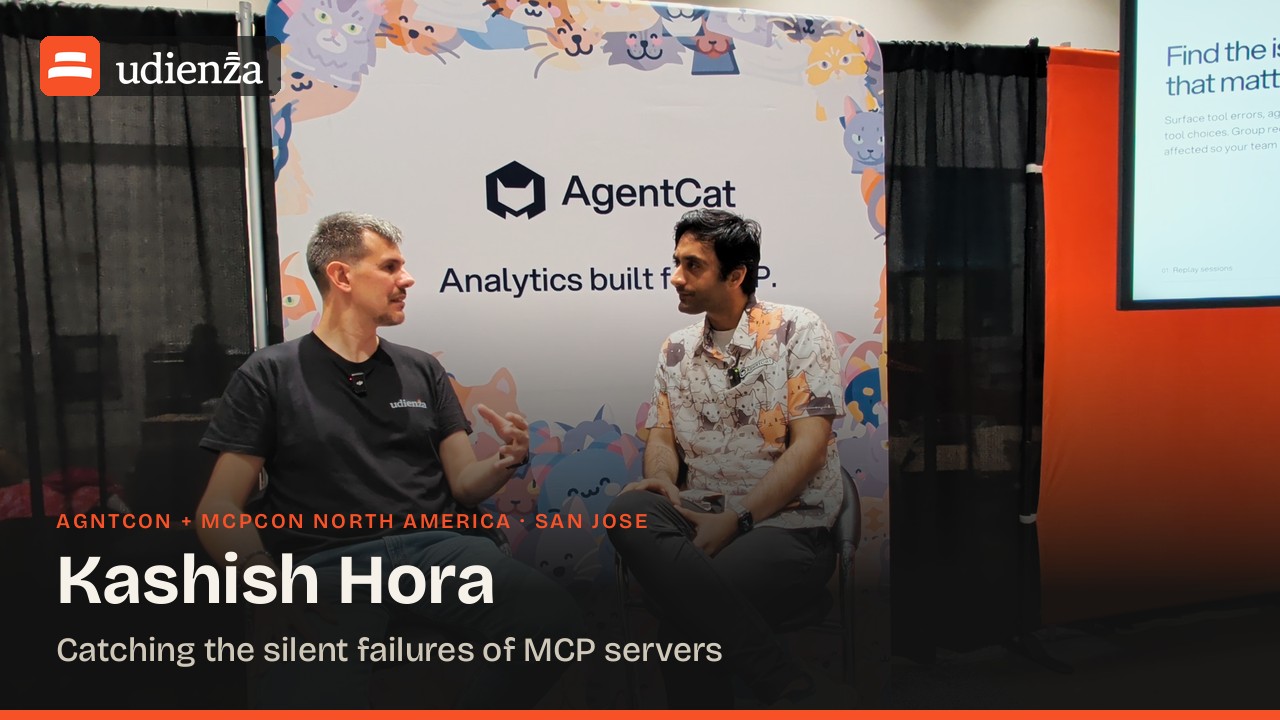
Not filmed yet.
Kashish Hora works at AgentCat, whose product helps companies that build MCP servers understand how agents use them and where they get stuck.
Follow the show and the episode arrives the morning it's published.
In brief
- Building an MCP server is easy now, with the SDKs the MCP developer community has made; once it is released, understanding how agents use it is still hard.
- Silent failures, an agent that gives up, abandons a session early or calls the wrong tool, do not show in logs and traces, which catch errors such as authentication failures.
- AgentCat's SDKs cover the major MCP languages, among them TypeScript, Go, Python and Ruby: one line installs one on an MCP server and instruments it automatically.
- When an agent cannot do what the user asked, it can report that back to the developer, who collects the feedback over time to improve the server.
- It is not an API gateway and does not sit between the MCP server and the API: it lives on the MCP server, and can export its data to any OpenTelemetry collector.
- He expects the most successful companies of the next two decades to be those that prioritize how agents experience their product, as agents become the biggest users of software.
- After MCP, AgentCat is working on WebMCP, browser use and standards such as A2A and UCP; Webflow is one of its biggest customers, and the product is self-serve and free to try at agentcat.com, with open source SDKs.
Chapters
- 0:00 AgentCat: analytics for MCP servers
- 0:31 Easy to build, hard to understand
- 1:10 Silent failures
- 1:38 One line to install the SDK
- 2:29 Agents that give up, and tell you
- 3:03 OpenTelemetry, not a gateway
- 4:03 Agents as the biggest users
- 5:13 WebMCP, A2A, UCP and more
- 6:03 New roles: head of agent experience
- 6:41 A customer: Webflow
- 7:14 Free to try
Why this conversation
Building an MCP server has become easy; knowing what agents do with it once it is out is not. Kashish Hora works at AgentCat (“first of all, we are a bunch of founders and cat lovers and dog lovers”), which helps the companies that build MCP servers see how agents use them and where they get stuck. The host talked to him in San Jose on Friday 23 October, the second day of AGNTCon + MCPCon North America. Everyone else the show met that Friday is in AGNTCon + MCPCon North America 2026: day two.
Silent failures
“Building an MCP server is really easy nowadays. There’s many tools to help you get started.” The hard part is what comes after the release. Logs and traces catch the errors that are easy to catch, such as an authentication failure. What they miss, Kashish says, are silent failures: an agent that tries to do something for the user and cannot, because the server lacks the function or it is hard to find, and gives up, abandons the session early, or calls the wrong tool and gets confused. For the user, it looks as if the tool does not support what they asked.
AgentCat’s SDK is one line to install, in the major languages MCP servers are written in (“TypeScript, Go, Python, Ruby, whatever it might be”), and it instruments the server automatically, almost like middleware. The agent can then report back what it could not do, and the developer collects that feedback over time to improve the server. The data can also go to any OpenTelemetry collector. “So it’s not built on top of OpenTelemetry, it exports OpenTelemetry”, the host checked. “Exactly.” The goal is not to replace the analytics and observability already in place: “Our goal is to give you an entirely new way to understand how agents are experiencing your MCP server.” Nor is it a gateway; it lives on the MCP server itself.
The agent experience
For two decades, companies built products around how people use them: websites, web apps, forms. Kashish expects the most successful companies of the next two decades to be the ones that prioritize how agents experience their product, because agents will be the biggest users of software. Today that mostly goes through MCP, “but you’re also seeing all these agents try workarounds like just opening your website and trying to click on buttons in a way that was meant for humans”. AgentCat starts with MCP and is working on WebMCP, plain browser use, and standards such as A2A and UCP. The host, who had been at Nordic APIs, raised the problem that agents do not know a user’s workflow and try every path. “It’s a different way of thinking about software development, and for a lot of organizations, it’s a new muscle”, Kashish answered. He also sees new roles appear for this, such as head of agent experience. Webflow is one of the customers it has helped as its MCP server grew.
Getting started
AgentCat has “a website and a product that’s fully self-serve and free to try and free to use. All of our SDKs are open source. You can get started at agentcat.com.”
When it comes out
The episode is edited and in the release order. Like every episode it goes out on YouTube first, then on Apple Podcasts, Spotify and Amazon Music.
Mentioned in this episode
About Kashish Hora
Kashish Hora works at AgentCat, whose product helps companies that build MCP servers understand how agents use them and where they get stuck.
Running this in production? Luca Berton helps platform teams take it from prototype to reliable production. See how he works
Built something the rest of us run on? Being a guest is free. Take the other chair
More episodes
All episodes →-
Episode 81 · Coming
Katherine Druckman: The human part of AI development
-
Episode 83 · Coming
Shaun Smith: Stateless MCP
-
Episode 78 · Coming
Matt Meeboer: Hard-to-reach data for every agent
-
Episode 77 · Coming
Sanford Redlich: Governing agents across the network