Coming soon 9:37 Recorded at AGNTCon + MCPCon North America, San Jose
How do you govern unpredictable agents across a whole corporate network?
Governing agents across the network
Sanford Redlich, Head of Engineering at Alterion, on seeing every agent on a network, classifying it with AI on premises, and controls drawn around a team.
Sanford Redlich, Head of Engineering, Alterion · with  Luca Berton
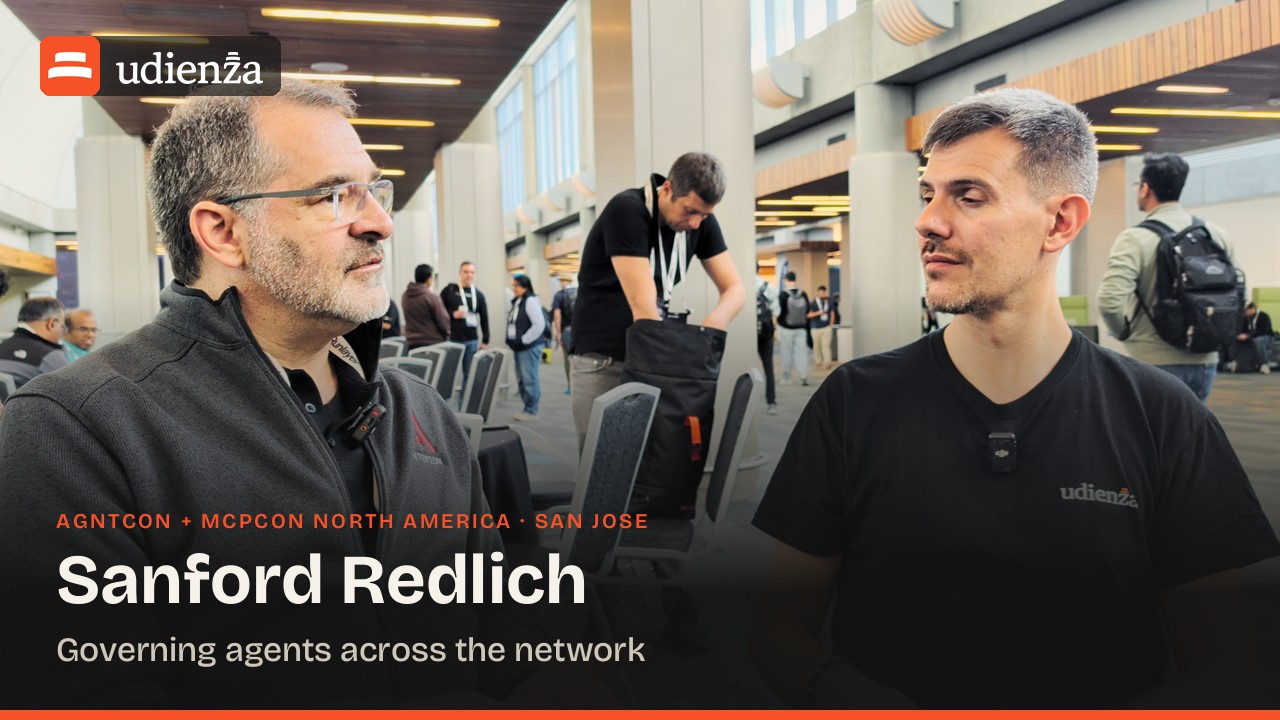
Not filmed yet.
Sanford Redlich is Head of Engineering at Alterion, which governs AI on large corporate systems: it observes agentic behaviour across the network and, if necessary, controls it.
Follow the show and the episode arrives the morning it's published.
In brief
- Alterion's first differentiator is completeness: it watches agentic behaviour from the endpoints out to SaaS services and classifies what matters, such as compliance, legal and return on investment.
- It runs on premises, air-gapped if needed, and classifies with a proprietary AI system, since in his view a deterministic system cannot govern non-deterministic agents.
- Even one endpoint is hard: the Claude app, Copilot and VS Code have API control planes, but many other agents, and their calls to MCP servers on the network or over standard IO, have to be intercepted.
- Among the companies Alterion talks to, one has 10,000 agents of a single kind, so the interface is visual, made to make sense to a CISO or to a leader responsible for compliance.
- The classification aims to catch violations of GDPR Article 9 and Article 22, and when a team such as finance looks odd, the investigate button shows its traffic, people and agentic workloads.
- A control can then be set for a boundary like the finance department, so that agents of one type there cannot send certain information; social security numbers are the simplest case.
- Alterion is working with healthcare, finance and big tech, and he calls agents a third kind of entity: unpredictable like people, yet very fast, enough to make any CEO nervous.
Chapters
- 0:00 Governing AI on corporate systems
- 0:41 On-prem and air-gapped
- 0:55 Seeing agents across the network
- 1:23 Three differentiators
- 1:57 Governing the non-deterministic
- 2:25 Agents on an endpoint
- 2:57 MCP over the network and stdio
- 4:26 Hundreds of thousands of agents
- 5:27 GDPR and compliance
- 6:24 Investigate, then control
- 7:11 Healthcare, finance, big tech
- 7:50 A third kind of entity
- 8:22 Getting in touch
Why this conversation
A large company can already have thousands of agents on its network, each kind talking in its own way. Alterion’s work is to find them, understand what they do and, where needed, rein them in. Sanford Redlich is its Head of Engineering. The host recorded with him on 23 October 2026, the second day of AGNTCon + MCPCon North America in San Jose, and asked what Alterion does, how hard the engineering is, and who it is for. The day’s other conversations are collected in the article on day two.
What sets Alterion apart
Alterion governs AI on large corporate systems. Asked what makes it different, Sanford lists three things. The first is completeness: it covers the whole network, from the endpoints, through the network and the communications, out to other entities such as SaaS services, and it classifies many kinds of agentic behaviour that matter, among them compliance, legal and return on investment. When the host suggested it was an incident response tool, Sanford said the system is good at that, but its main job is to observe the behaviour, identify it and, if necessary, control it, warn about it or act in some other way.
Second, Alterion installs on premises, air-gapped if needed, so nobody has to ship precious data to an outside SaaS operation. The third is a proprietary AI system that does the classification. That choice follows from what is being governed: agents are unpredictable and non-deterministic. “And if you use a deterministic system to try to govern them, you will fail.” The governing system has to adapt as fast as the things it controls.
Harder than it sounds
To show the engineering problem, Sanford takes a single endpoint. Some agents there, such as the Claude app, Copilot and VS Code, offer API control planes that you can log into to see what they do. Many others have no such control plane; for those, the only way is to intercept the traffic and decode it until the behaviour can be spotted. The agents may also call MCP servers on the network, which have to be catalogued, or MCP servers on the same machine over standard IO, whose traffic has to be intercepted too.
“These things that sound very simple are not at all simple.” That, he says, is why the team needs engineers who understand systems, system design and system dynamics, and who are at ease with how quickly agentic development moves, because Alterion has to move faster than what it observes.
The interface is very visual, partly because of the volume. One company Alterion talks to runs 10,000 agents of a single kind, and the total could easily reach the hundreds of thousands. “I can promise you that they are not communicating using any standard other than maybe MCP.” Everything has to be sorted, with few mistakes, and shown in a form that makes sense to a CISO or to a leader responsible for a team’s compliance.
From an odd signal to a control
The host raised Europe’s regulations. Sanford has dived into GDPR Article 9 and Article 22, because the company cares a lot about compliance and the classification must catch violations. The flow starts from an overview of a company or team and the agents on its network. Say finance looks odd: the investigate button reveals the traffic, the people involved and the agentic workloads on that system. Then you can add the control you wish you had set earlier: draw a boundary, such as the finance department, and stop agents of a given type inside it from sending certain information. Social security numbers are the trivial case; the controls can be far more fine-grained.
Alterion’s customers are in healthcare, finance and big tech; the company is in the United States and beginning to work abroad. For a lot of companies, he says, regulation is difficult and scary. Sanford describes agents as a third kind of entity on the network: people were unpredictable but went through HR, and deterministic software did what it was told, while agents are unpredictable and very fast. “And if you’re a CEO and you’re not nervous about this, I don’t know what would make you nervous.”
To get in touch, the way is the website, alterion.ai, and a sales conversation. There is no download or installation for now: Alterion is optimised for Fortune 100 and Fortune 500 customers, and plans to widen that over time.
When it comes out
The episode is edited and in the release order. Like every episode it goes out on YouTube first, then on Apple Podcasts, Spotify and Amazon Music.
Mentioned in this episode
About Sanford Redlich
Sanford Redlich is Head of Engineering at Alterion, which governs AI on large corporate systems: it observes agentic behaviour across the network and, if necessary, controls it.
Running this in production? Luca Berton helps platform teams take it from prototype to reliable production. See how he works
Built something the rest of us run on? Being a guest is free. Take the other chair
More episodes
All episodes →-
Episode 76 · Coming
Tyler Lamparter: MCP servers with governance built in
-
Episode 78 · Coming
Matt Meeboer: Hard-to-reach data for every agent
-
Episode 75 · Coming
Spencer Reagan: Securing agents inside the enterprise
-
Episode 38 · Coming
Andrew Linehan: Governing the agents your teams already use