Coming soon 6:19 Recorded at AGNTCon + MCPCon North America, San Jose
How do agents reach a company's back-end systems without losing governance?
MCP servers with governance built in
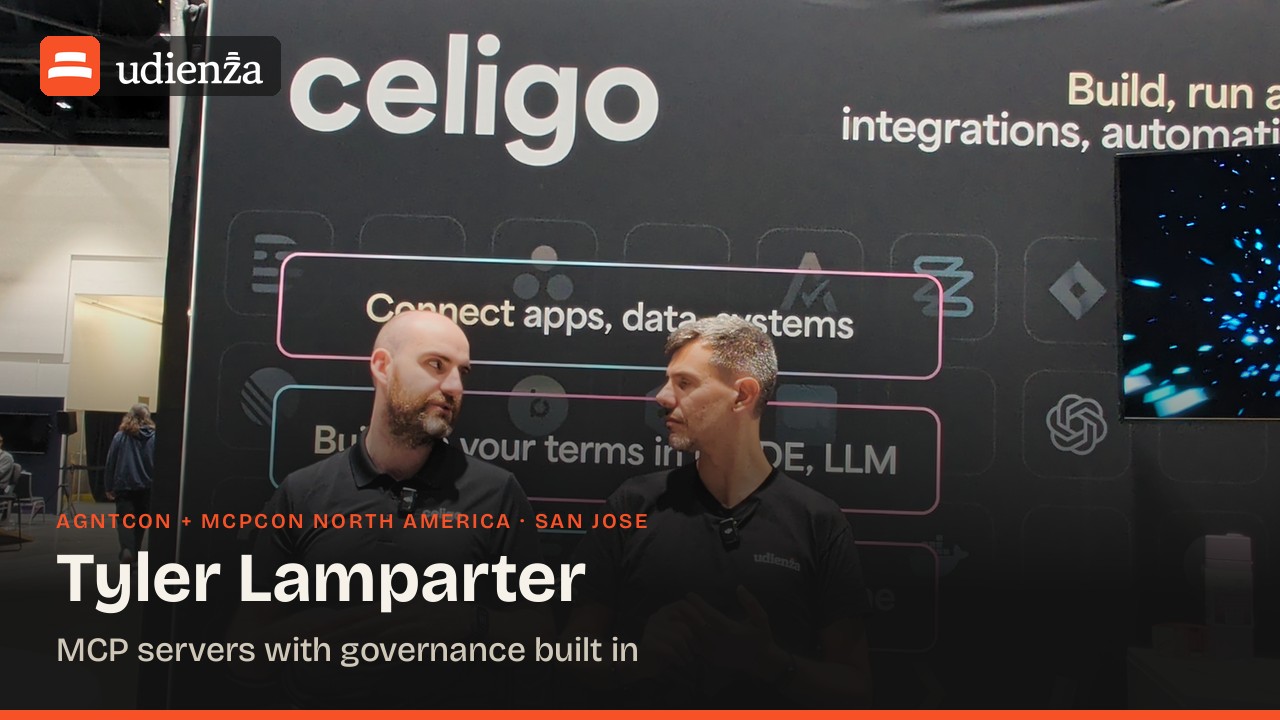
Tyler Lamparter, Product Manager at Celigo, on MCP servers with governance built in, a proxy for vendor servers, and earned autonomy in finance automation.
Tyler Lamparter, Product Manager, Celigo · with  Luca Berton
Not filmed yet.
Tyler Lamparter is a product manager at Celigo, an integration platform as a service that has connected back-end systems such as ERPs and CRMs for over 10 years. He joined four years ago from an e-commerce company that was a Celigo customer.
Follow the show and the episode arrives the morning it's published.
In brief
- Celigo is an integration platform as a service: for over 10 years it has connected back-end systems such as ERPs and CRMs, with connectivity to thousands of enterprise applications.
- MCP extends that connectivity to the agents people now have, so Celigo lets customers create MCP servers on its platform that reach back-end systems securely and with governance.
- What sets it apart, he says, is the governance layer, the traceability, auditability and observability of what agents do, in a single platform not bolted together from acquisitions.
- Instead of connecting straight to a vendor's MCP server from the Claude or Cursor marketplace, customers can proxy it through Celigo and restrict access down to individual tools.
- The free trial has every capability of the platform; agents built in it use your own keys or models Celigo hosts, while the MCP servers themselves need no AI.
- In finance automation, emails are fetched deterministically, agents sort them and draft replies, and a person reviews each reply and sends it.
- Celigo calls the idea earned autonomy: a deterministic flow earns the right to become more autonomous over time, with an agent only at the points where one is needed.
Chapters
- 0:00 Celigo: integration as a service
- 0:32 From integrations to MCP servers
- 1:13 Governance built in, not bolted on
- 1:45 E-commerce customers
- 2:16 Managing MCP servers
- 2:48 Proxying vendor MCP servers
- 3:29 Free trial, your own keys
- 4:13 Finance automation from the inbox
- 5:19 Earned autonomy
Why this conversation
Companies that already wire their back-end systems together now want their agents to reach those systems too, and every new path in needs to be secured and watched. Tyler Lamparter is a product manager at Celigo, and the host recorded with him on 23 October 2026, the second day of AGNTCon + MCPCon North America in San Jose. They talked about how an integration platform becomes a place to run MCP servers, why governance has to come with it, and a finance use case that keeps a person in the loop. The day’s other conversations are in the article on day two.
From integration to MCP
Celigo, Tyler explains, is an integration platform as a service. It has been around for over 10 years, linking ERPs, CRMs and other back-end systems and migrating data between them, and its connectors reach thousands of enterprise applications.
The host asked how agentic AI fits in. Neatly, in Tyler’s view. Celigo already had the connectivity to a company’s back-end enterprise systems, and employees want to reach those systems through their agents. MCP extends that reach to the agents people now have, and Celigo’s answer is to let customers create MCP servers on the platform, so agents get to those systems securely and under governance.
Why governance is the point
With so many companies at the conference doing similar work, the host asked what makes Celigo a specialist. The first answer is the governance layer, which counts for a great deal with agents: traceability, auditability and observability of what happens when agents call back-end systems, for organisations with high security and governmental requirements. The second is that all of it lives in one platform, rather than in pieces bolted together through various acquisitions.
Many customers are in e-commerce, running their businesses on Shopify and Amazon and selling just about anything. Tyler knows that world: “So I actually came from a customer of Celigo.” He joined four years ago from an e-commerce company and now works on the product side, helping other customers.
A proxy for vendor MCP servers
Several product areas are his, but MCP servers take most of his attention, in particular the management layer on top of them. Many customers pick an MCP server from the Claude or Cursor marketplace and talk straight to the vendor’s server. Through Celigo they can proxy those servers instead and add governance: who is calling what, why they are calling it, and who has access to what, restricted down to the individual tools within a server.
Asked how a company would adopt it, Tyler points to the website: sign up, or spin up the free trial, which comes with every capability of the platform. His team will also meet you, show a demo and even build things for your business. Does a customer need to bring its own AI? Agents built inside the platform can use your own keys, or models that Celigo hosts from providers it has contracts with. “But then the servers themselves, right, don’t need AI.” A server simply exposes tools and connectivity, and the system keys are the customer’s own.
Earned autonomy in finance
The biggest use case Tyler sees, both inside Celigo and across its customers, is finance automation. Finance teams often work in email inboxes shared with vendors, receiving PDF files and requests: update the billing information, send the last invoice or a receipt. AI is great, he says, but a lot of this work is deterministic. “So you put AI specifically where you need it in that deterministic process.” The emails are fetched deterministically. An agent sorts them into categories. Another finds the information it needs and drafts a reply, but leaves the sending to a person, who reviews it first. The host saw it as a human in the loop.
Celigo is coining a name for the idea: earned autonomy. A flow earns the right, over time, to become more autonomous. In most of the processes Celigo sees, an agent is needed only at specific points, and everything else is fully deterministic. The host, for one, wants to try it on his own accounting.
When it comes out
The episode is edited and in the release order. Like every episode it goes out on YouTube first, then on Apple Podcasts, Spotify and Amazon Music.
Mentioned in this episode
About Tyler Lamparter
Tyler Lamparter is a product manager at Celigo, an integration platform as a service that has connected back-end systems such as ERPs and CRMs for over 10 years. He joined four years ago from an e-commerce company that was a Celigo customer.
Running this in production? Luca Berton helps platform teams take it from prototype to reliable production. See how he works
Built something the rest of us run on? Being a guest is free. Take the other chair
More episodes
All episodes →-
Episode 75 · Coming
Spencer Reagan: Securing agents inside the enterprise
-
Episode 77 · Coming
Sanford Redlich: Governing agents across the network
-
Episode 78 · Coming
Matt Meeboer: Hard-to-reach data for every agent
-
Episode 72 · Coming
Hari Krishna Sunder: A context layer for every agent