Coming soon 2:28 Recorded at Open Source Summit Europe, Prague
What does OpenBao 2.7 add for teams that run their own secrets?
OpenBao 2.7: post-quantum and HSM keys
Alex Scheel of Control Plane on OpenBao 2.7: horizontal scaling on Postgres, PKI roots backed by an HSM, post-quantum support, and what comes next.
Alex Scheel, Head of OpenBao Development,  Control Plane · with
 Luca Berton
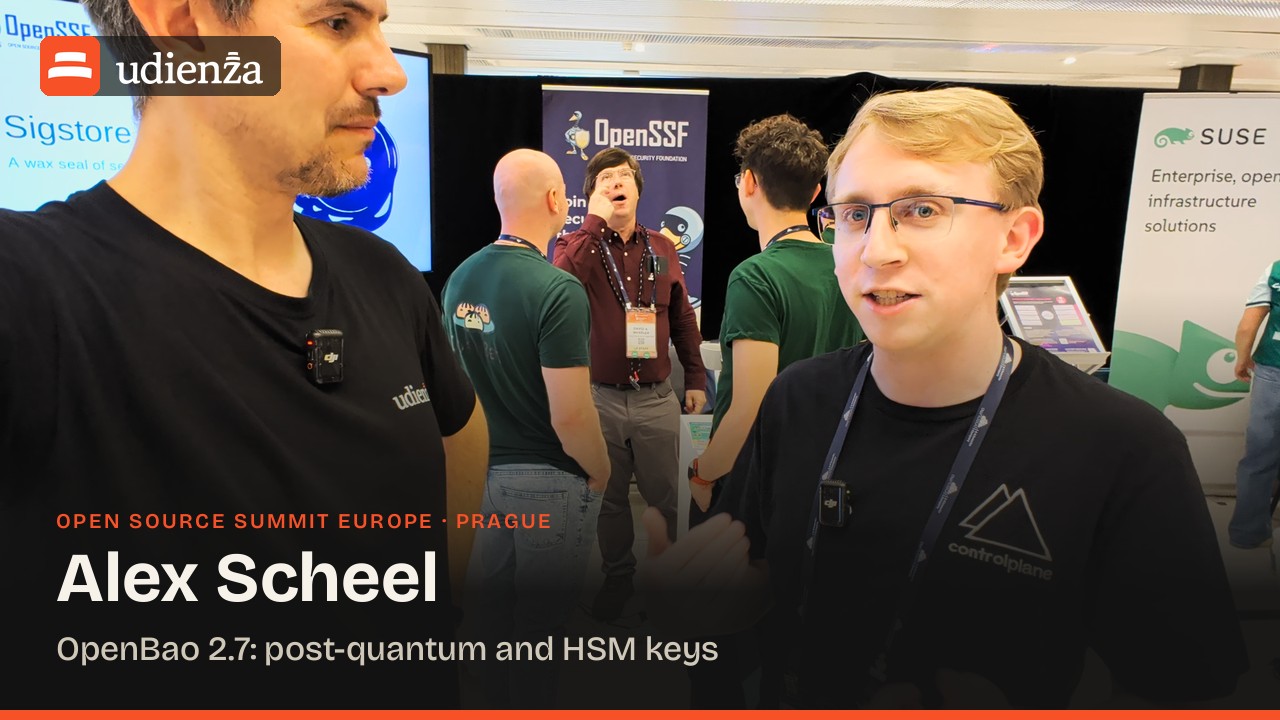
Not filmed yet.
Alex Scheel is Head of OpenBao Development at Control Plane and a founding engineer of OpenBao, the community fork of HashiCorp Vault hosted by the OpenSSF.
Follow the show and the episode arrives the morning it's published.
In brief
- OpenBao 2.7 shipped at the end of September, about two weeks before the conversation.
- It adds horizontal scalability on top of Postgres.
- External key support lets a PKI root be backed by an HSM, similar to Vault Enterprise's managed keys.
- It also ships post-quantum support: signature algorithms and key exchange mechanisms meant to hold for the next 30 to 50 years.
- Next on the roadmap: more authorization mechanisms, as an external plugin or in OpenBao itself, to replace Sentinel support.
- Moving from read to write scalability will take substantial changes to the core architecture.
- To get involved: the OpenBao project on GitHub and its Zulip channel, or just tell the team you use it.
Why this conversation
Secrets management sits under almost everything a platform team runs, and OpenBao is the community fork of HashiCorp Vault that many of those teams now look at. At Open Source Summit Europe in Prague, the host caught up with Alex Scheel, Head of OpenBao Development at Control Plane, near the OpenSSF area. The two had already met at PlatformCon in London. This is a short conversation, about two and a half minutes, on what the latest release changed. The rest of the week is in Open Source Summit Europe 2026: who we met.
What OpenBao 2.7 shipped
Alex has heard from a number of customers and community members running OpenBao, and the release he points to is OpenBao 2.7, out at the end of September. It brought horizontal scalability on top of Postgres. It brought external key support, so a PKI root can now be backed by an HSM, with key material handled in a way similar to Vault Enterprise’s managed keys.
And, as he put it, “not to bury the lede”: 2.7 also ships post-quantum support. He acknowledges that the term has become a buzzword. The need is concrete, though. Governments are moving to new cryptographic algorithms around 2030, and people need signature algorithms and key exchange mechanisms that stay resistant for the next 30, 40 or 50 years.
What comes next
The roadmap has two main lines. The first is support for additional authorization mechanisms, built either as an external plugin or into OpenBao itself, as a replacement for Sentinel support. The second is moving from read scalability to write scalability, which will require a lot of changes to the core architecture. Beyond features, he wants to keep building trust in the platform the project has already built.
Getting involved
The starting point is the OpenBao project on GitHub, and the project has a Zulip channel. Users can also post about it on LinkedIn. Alex’s simplest request: tell the team that you are using it.
Mentioned in this episode
About Alex Scheel
Alex Scheel is Head of OpenBao Development at Control Plane and a founding engineer of OpenBao, the community fork of HashiCorp Vault hosted by the OpenSSF.
Running this in production? Luca Berton helps platform teams take it from prototype to reliable production. See how he works
Built something the rest of us run on? Being a guest is free. Take the other chair
More episodes
All episodes →-
Episode 53 · Coming
Raymond de Jong: Private networks for VMs on Kubernetes
-
Episode 55 · Coming
Curtis Schofield: On call for everyone
-
Episode 58 · Coming
Tony: Secrets and identity for AI agents
-
Episode 43 · Coming
Konstantin Ryabitsev: How the kernel is built by email