Coming soon 5:57 Recorded at TalosCon, Amsterdam
How do you give VMs on Kubernetes the networking they had on VMware?
Private networks for VMs on Kubernetes
Raymond de Jong, Field CTO EMEA at Isovalent, on Isovalent Private Networks: persistent, multi-tenant networking for virtual machines on Kubernetes.
Raymond de Jong, Field CTO EMEA, Isovalent · with  Luca Berton
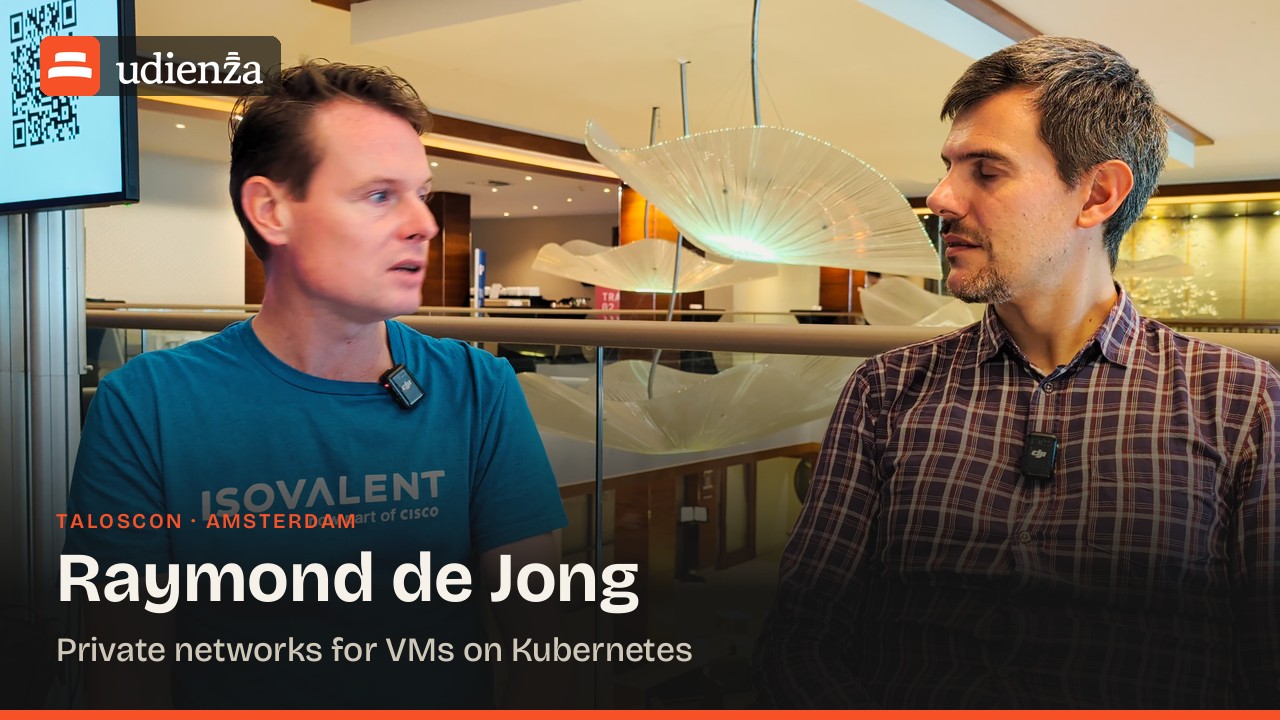
Not filmed yet.
Raymond de Jong is Field CTO EMEA at Isovalent, the company behind Cilium. At TalosCon 2026 in Amsterdam he presented Isovalent Private Networks, a VPC for the Kubernetes cluster.
Follow the show and the episode arrives the morning it's published.
In brief
- Isovalent Private Networks is in effect a VPC for the Kubernetes cluster, aimed at VM connectivity without the complexity of Kubernetes networking.
- Pod IPs are ephemeral; VM IPs stay with long-lived VMs, so private networks give VMs persistent networking with their own subnets and routes.
- It is the primary network, not a secondary interface as with Multus; under the hood it relies on KubeVirt.
- Annotations give a VM a static IP and a private network, with direct VLAN access or EVPN with VXLAN, and BGP advertising the networks to the fabric.
- Tenants get one or more private networks each, for routing separation, plus Cilium network policies for security separation.
- Today a private network spans one cluster; spanning clusters, in a Cluster Mesh-like experience, is on the roadmap.
- IPv6 networks, subnets and BGP peering are already supported; egress gateway and load balancing integration is in progress.
- Across clusters, private networks target the availability and recovery cases VMware customers built with NSX.
Chapters
- 0:00 Isovalent private networks for VMs
- 1:00 Built on KubeVirt, not Multus
- 2:36 Multi-tenant, overlapping ranges
- 3:32 Across clusters, IPv6 and more
- 4:26 Disaster recovery and air gaps
- 5:22 Where to follow: Isovalent and Cisco
Why this conversation
Many teams moving off VMware want to run their virtual machines on Kubernetes, next to their containers. The difficulty is the network. Kubernetes networking was built for pods that come and go, while VMs live for a long time and expect to keep their addresses, their subnets and their place in the data centre’s network. The host met Raymond de Jong, Field CTO EMEA at Isovalent, at TalosCon in Amsterdam on 15 October, where Isovalent was showing its answer: Isovalent Private Networks. Everyone the show has met from the company is on Isovalent: the people on Udienza.
A VPC for the Kubernetes cluster
Raymond describes private networks as basically a VPC for the Kubernetes cluster. The aim is to solve VM connectivity without the complexity of Kubernetes networking. The two worlds differ: pod IPs are ephemeral, but a VM’s IP is sticky to the VM, and VMs are long-lived. Private networks let you configure persistent networking for virtual machines and define subnets and routes for each private network, which gives proper multi-tenant networking for VMs on top of Kubernetes.
The host asked whether this is the primary network or a secondary interface, as with Multus. It is the primary network. Under the hood it relies on KubeVirt, which connects the pod network to the VM’s interface; private networks abstract that away. A simple annotation gives a VM a static IP, and another says which private network it belongs to. The VM is then connected to that network in its own routing domain, and can reach the network fabric with direct VLAN access or through EVPN.
For teams coming from VMware with traditional VLAN-based port groups, the path is direct VLAN access. You configure a VLAN for a private network and define the interface the host should use, and a VM on that network gets layer 3 access, for example to a default gateway on that VLAN. The alternative is overlay networking with EVPN and VXLAN, with BGP as the control plane advertising private networks to the fabric, so that a network administrator can route them across the network and between data centres.
Tenants, clusters and IPv6
For multi-tenancy, each tenant can have one or more private networks, each with a default and per-subnet configuration. On top of that, Cilium network policies isolate tenants for security. The result is two layers of separation: routing, and network policy.
Spanning clusters is on the roadmap. Today a private network lives within one cluster; the work under way will let it span several, in an experience similar to Cluster Mesh. IPv6 is already supported: you can define IPv6 networks and subnets and do BGP peering over IPv6. The integration still to come is with the egress gateway and load balancing capabilities. Once that is done, Raymond says, the multi-tenant capabilities will cover the whole ingress and egress stack.
Recovery across clusters
The host asked about disaster recovery and disconnected environments. What Raymond sees most is VMware-based customers who used NSX for availability or recoverability: several clusters, load balancing traffic across them, or recovering workloads in a different cluster. Private networks that span clusters are meant to deliver the same outcome.
Where to follow it
New capabilities are announced on the Isovalent website, with blog posts and YouTube videos from the team. Announcements also come through the Cisco website, and for integration with Cisco technology there are Cisco integration and validated design guides.
Mentioned in this episode
About Raymond de Jong
Raymond de Jong is Field CTO EMEA at Isovalent, the company behind Cilium. At TalosCon 2026 in Amsterdam he presented Isovalent Private Networks, a VPC for the Kubernetes cluster.
Running this in production? Luca Berton helps platform teams take it from prototype to reliable production. See how he works
Built something the rest of us run on? Being a guest is free. Take the other chair
More episodes
All episodes →-
Episode 52 · Coming
Gertrude Chilufya: Reframing the future of work
-
Episode 54 · Coming
Alex Scheel: OpenBao 2.7: post-quantum and HSM keys
-
Episode 56 · Coming
Pepijn Oomen: Reviving Cluster API for Talos Linux
-
Episode 46 · Coming
Giordana Fung: Own your files with ownCloud