Sidero Labs
3 min read
Steve Francis on Talos in the AI era
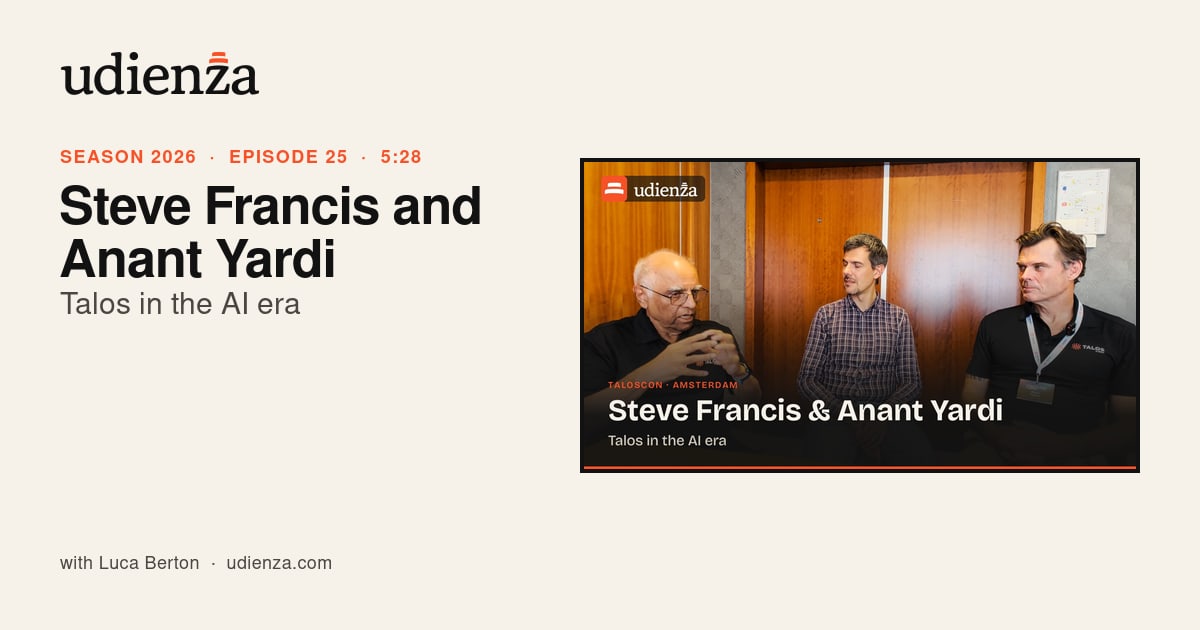
Steve Francis, President of Sidero Labs, at TalosCon 2026: Talos Enterprise Linux, a hypervisor, Talos AI and Director, and sovereign private clouds.
By  Luca Berton
Who Steve Francis is
Steve Francis is President of Sidero Labs, the company behind Talos Linux, the minimal, API-managed operating system for Kubernetes nodes, and Omni, the management plane that runs fleets of it. Most platform teams know Talos as the locked-down OS underneath their clusters: no shell, no SSH, configured entirely through an API.
The conversation
Steve sat down with the show at TalosCon in Amsterdam on 15 October 2026, the day the company laid out where Talos goes next, together with Anant Yardi, founder of Yardi Systems, which acquired Sidero Labs a month earlier. The short version is that Talos is no longer only the OS under Kubernetes: it is being positioned as the base of a private cloud that also runs virtual machines and AI workloads.
A run of announcements
Steve opened with the list. First, Talos Enterprise Linux, which packages the security artifacts that enterprises need for NIS2 and Cyber Resilience Act compliance. Then the Talos hypervisor, demonstrated at the conference. Then Talos AI, Talos Director and Talos Cupar, the last two presented on stage by Yardi.
The pace is the story behind the list. Anant and Steve did not know each other four months earlier; an email and a call in New York later, the two companies were one, announcing all of this together. The reaction on the floor, they said, was very positive, with solid reviews for Director and, they believe, a first sale already.
Sovereignty, and what it costs
Sovereignty comes up in every European conversation about infrastructure now, and the answer here works on two levels. On the infrastructure side, Talos Linux and Director set up a private cloud environment. On the AI side, open-weight models mean the data that belongs to a company can stay inside that company’s private cloud. The added benefit, as they put it, is that it can save a lot of money.
Releasing more often, upgrading less painfully
The practical question for anyone running Talos is the release cycle. Traditionally Talos Linux followed Kubernetes: every new Kubernetes release was supported by a Talos release the next day, roughly every four months. Now Talos also runs standalone containers and the hypervisor, so it will probably release more often, at least every three months and perhaps faster, depending on what customers and the market ask for.
That does not mean upgrading more often. Customers already find a four-month cycle hard to keep up with, so the work is going into making change friction-free: configuration that applies without a reboot, and nodes that keep running while they are upgraded.
A conference that keeps doubling
TalosCon itself is the other measure. This was the third in-person edition, and attendance went from about 100 people in the first year to about 250, and then to about 500. A first TalosCon in the United States is planned for early January, another European one will follow, and the team will be at KubeCon in Salt Lake City with more to share.
Where to go next
Everything starts at siderolabs.com: downloading Talos, signing up for Talos Enterprise Linux and Omni, applying for the Talos Director limited availability and hearing when Talos AI is available. Sidero Labs announced that it had joined Yardi on 14 September 2026, and Talos Linux stays under the MPL-2.0 licence. For the company itself, see Sidero Labs on Udienza.
Built something the rest of us run on? Being a guest is free. Take the other chair
Related articles
All articles →-
Conversations · 2 min read
Sidero Labs: Talos in the AI era
Steve Francis of Sidero Labs and Anant Yardi at TalosCon on Talos Enterprise Linux, the hypervisor, Talos AI, and private clouds that keep AI data sovereign.
-
Sidero Labs · 1 min read
Sidero Labs on Udienza: Talos beyond Kubernetes
Sidero Labs, the company behind Talos Linux and Omni, on Udienza: what TalosCon 2026 announced, and why Talos now aims to be the base of a private cloud.
-
Kubecon · 5 min read
KubeCon + CloudNativeCon Europe 2026: who we met
Amsterdam, 25 and 26 March: four conversations at KubeCon + CloudNativeCon Europe, on container security, observability, agents and a European cloud.