Conversations
2 min read
Isovalent: private networks for VMs on Kubernetes
A VPC for your Kubernetes cluster: Isovalent Private Networks gives VMs sticky IPs and their own subnets on KubeVirt, as Raymond de Jong explained at TalosCon.
By  Luca Berton
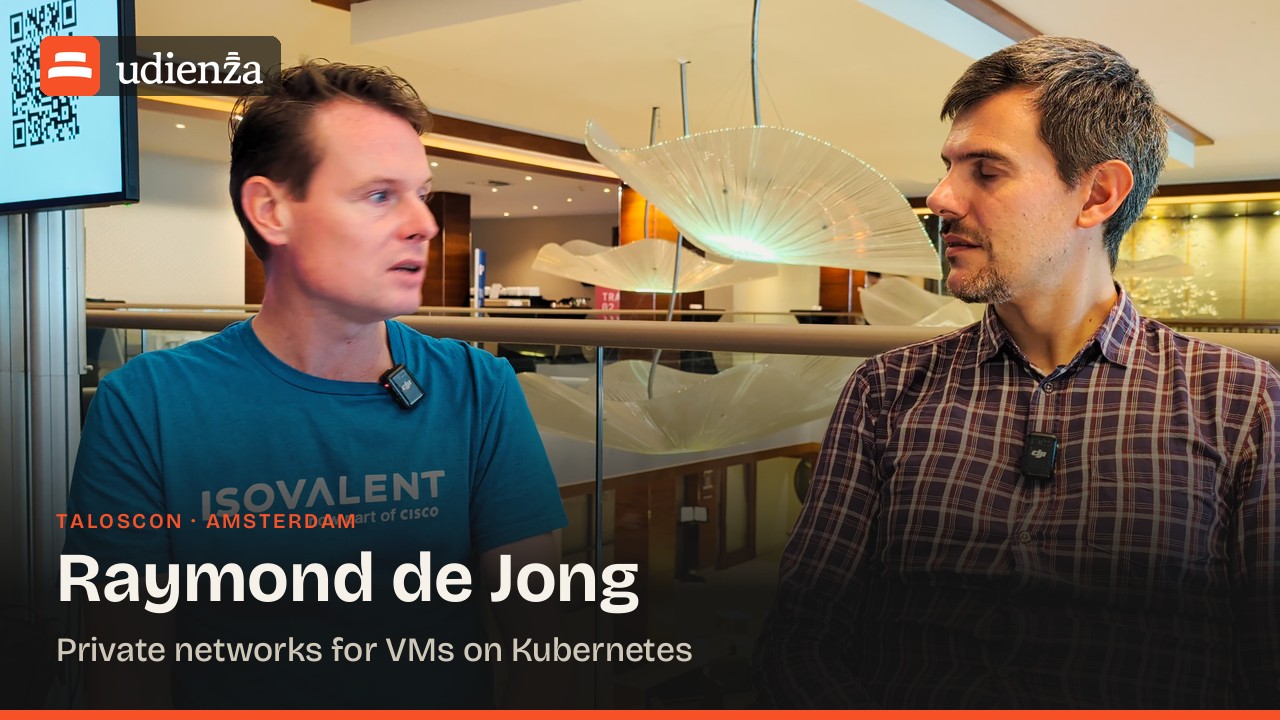
Raymond de Jong is Field CTO EMEA at Isovalent, at Cisco. Luca Berton talked to him at TalosCon in Amsterdam on 15 October 2026, where Isovalent was showcasing Isovalent Private Networks.
A VPC for your Kubernetes cluster
Isovalent Private Networks is “basically a VPC for your Kubernetes cluster”: it solves VM connectivity without the complexity of Kubernetes networking. The VM world is different. Kubernetes pod IPs are ephemeral, but VM IPs are sticky to the VM, and VMs are long-lived. Private networks give virtual machines persistent networking, with their own subnets and routes, so you can have proper multi-tenant networking for virtual machines on top of Kubernetes.
The primary network
It is the primary network, not a secondary interface as with Multus. Under the hood it relies on KubeVirt, which does the pod networking to a VM interface; private networks abstract that. A simple annotation gives a VM a static IP, another says which private network it belongs to, and the VM is connected to that network in its own routing domain, with direct VLAN access or with EVPN to the network fabric.
Coming from VMware
Teams using traditional VLAN-based port groups in VMware can move to private networks with direct VLAN access: configure a VLAN for a private network and define the interface the host uses. The networking is layer 3, so a VM can connect to a default gateway on a given VLAN. Or you can use overlay networking, EVPN with VXLAN, with BGP as the control plane advertising private networks to the fabric, so a network administrator can route them across the network and the data centers.
Tenants
You can define one or more private networks per tenant, each with routes per subnet. On top of that, network policies isolate tenants from a security perspective. “So you have a routing separation and you have a network policy security separation.”
Across clusters
Today a private network spans one cluster; spanning clusters is on the roadmap, in an experience similar to ClusterMesh. That is what VMware customers built with NSX: availability or recoverability across clusters, load balancing traffic across them or recovering workloads in a different cluster. “And with this private network across clusters, you can have the same outcome.”
IPv6, and what comes next
IPv6 is already supported on private networks: IPv6 networks and subnets, and BGP peering with IPv6. The integration points being worked on are the egress gateway capabilities and the load-balancing capabilities.
Where to learn more
New capabilities are announced on the Isovalent website, with blog posts and YouTube videos, or on the Cisco website, which also has the Cisco integration and validated design guides.
More
The episode with Raymond de Jong is edited and goes out on YouTube first, then on Apple Podcasts, Spotify and Amazon Music.
Built something the rest of us run on? Being a guest is free. Take the other chair
Related articles
All articles →-
Conversations · 3 min read
Edera: a micro-VM and a kernel for each workload
Kavitha Daula, VP of Engineering at Edera, on why containers sharing one kernel is a risk, zones per workload, and isolation for AI-written code.
-
Conversations · 1 min read
Reviving Cluster API for Talos Linux
Pepijn Oomen of Redpill Linpro asks the community to take over the Cluster API control plane and bootstrap providers for Talos Linux, marked deprecated.
-
Conversations · 2 min read
Sidero Labs: Talos in the AI era
Steve Francis of Sidero Labs and Anant Yardi at TalosCon on Talos Enterprise Linux, the hypervisor, Talos AI, and private clouds that keep AI data sovereign.

The episodes in this article
All episodes →-
Episode 53 · 12 Nov
Raymond de Jong: Private networks for VMs on Kubernetes