10 min read
AGNTCon + MCPCon North America 2026: the recap
Two days in San Jose: four new AAIF projects, 2 billion MCP tool calls in Claude, MCP Tasks, the first AAIF awards and twenty-two interviews.
By  Luca Berton
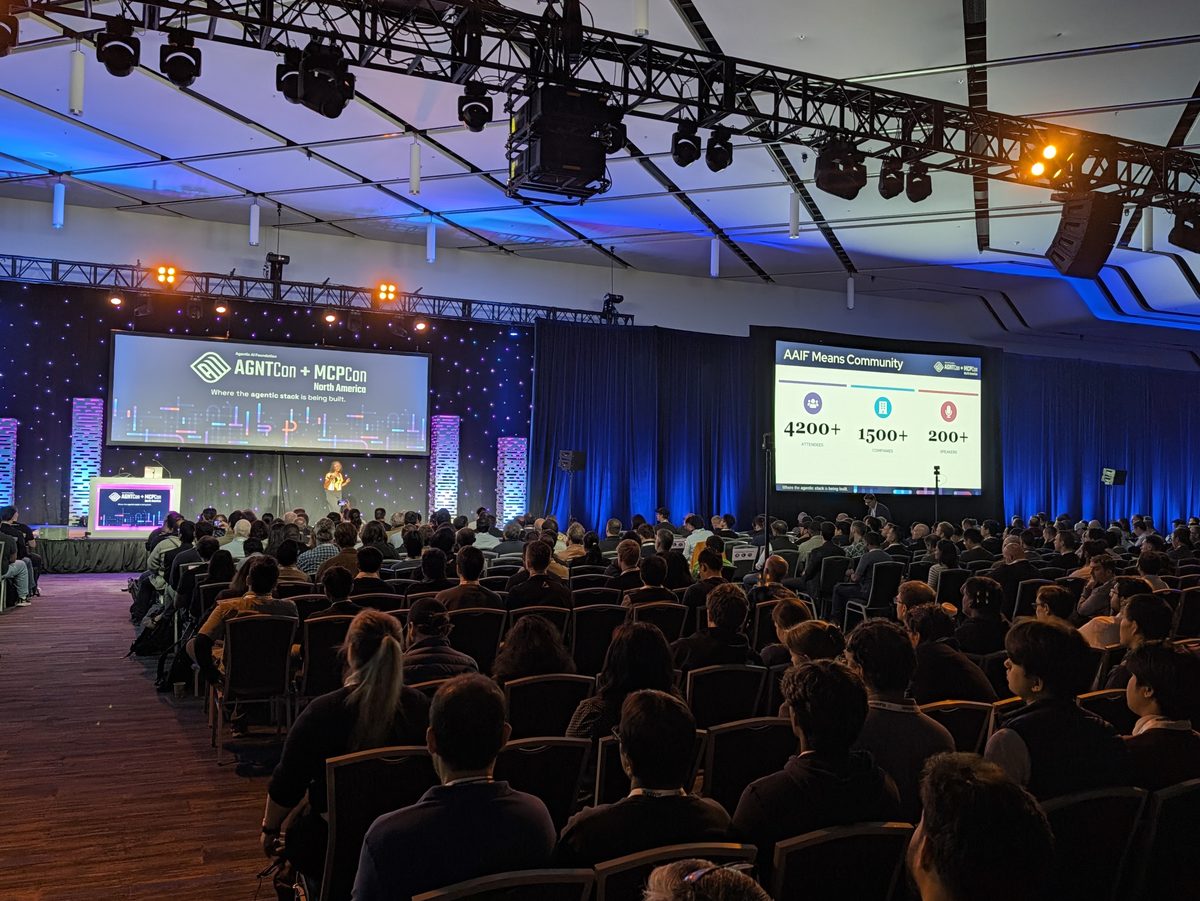
AGNTCon + MCPCon North America ran on Thursday 22 and Friday 23 October 2026 at the San Jose McEnery Convention Center. It is the Agentic AI Foundation’s conference, a month after the European edition in Amsterdam, and Udienza covered it as an official media partner. Each day has its own article, hour by hour: day one and day two. This page is the whole event in one read: the numbers, the announcements, what the stage and the booths kept coming back to, and the twenty-two people the host, Luca Berton, interviewed.
The event in numbers
- 305 members in the Agentic AI Foundation (AAIF), less than a year after it launched in December 2025, with 60 new member organisations this quarter.
- 10 projects, up from 3 at launch. Four arrived on day one: Agent Skills from Anthropic, Open Responses from OpenAI, OpenEnv from Hugging Face and OpenSandbox from Alibaba.
- 8 working groups, “open to anyone, and shipping”.
- 89% of the members surveyed use or evaluate MCP, and 81% run agentic AI in production today.
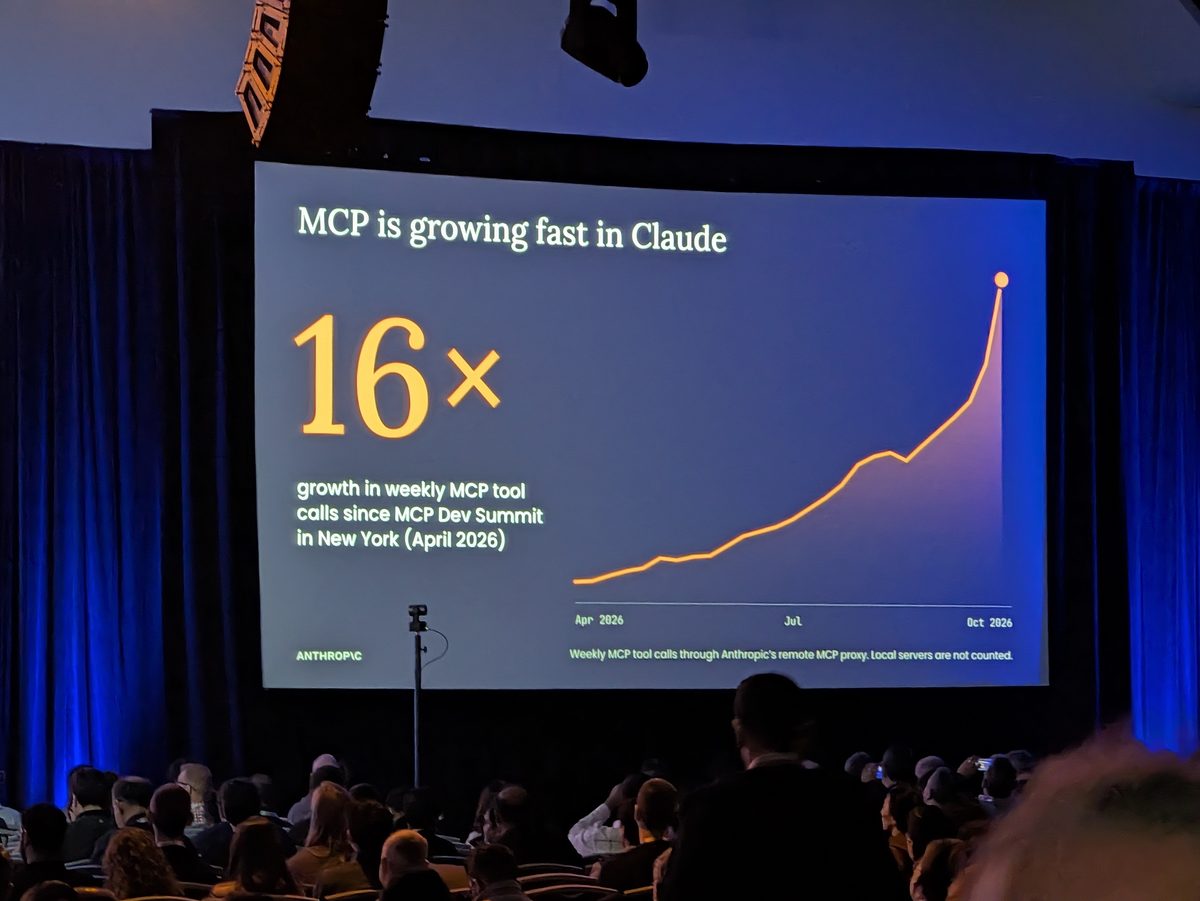
- 2 billion MCP tool calls in Claude, on day one. On day two, 16x growth in weekly MCP tool calls through Anthropic’s remote MCP proxy since the MCP Dev Summit in New York in April 2026.
- 6,000+ MCP servers in the Claude directory.
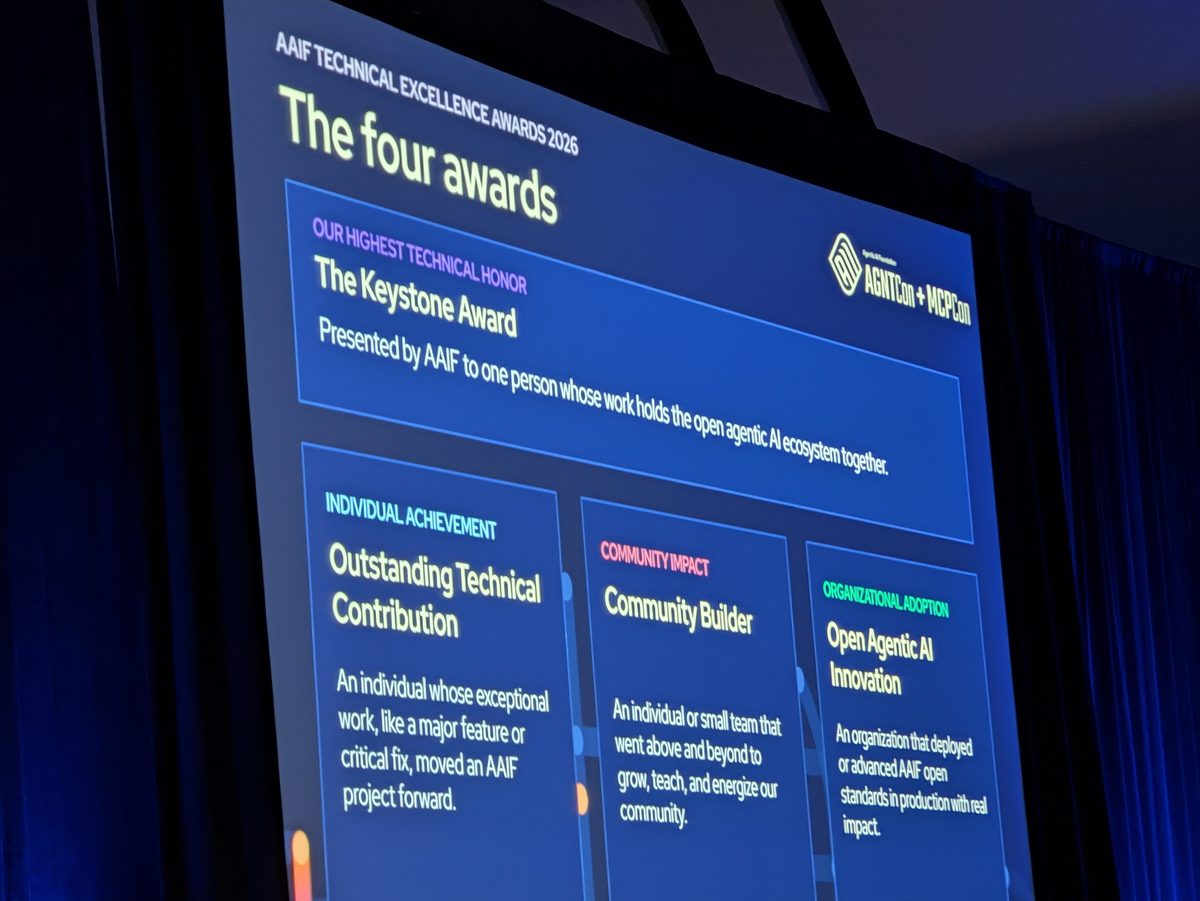
- 4 awards at the first AAIF Technical Excellence Awards, chosen by a committee of 10.
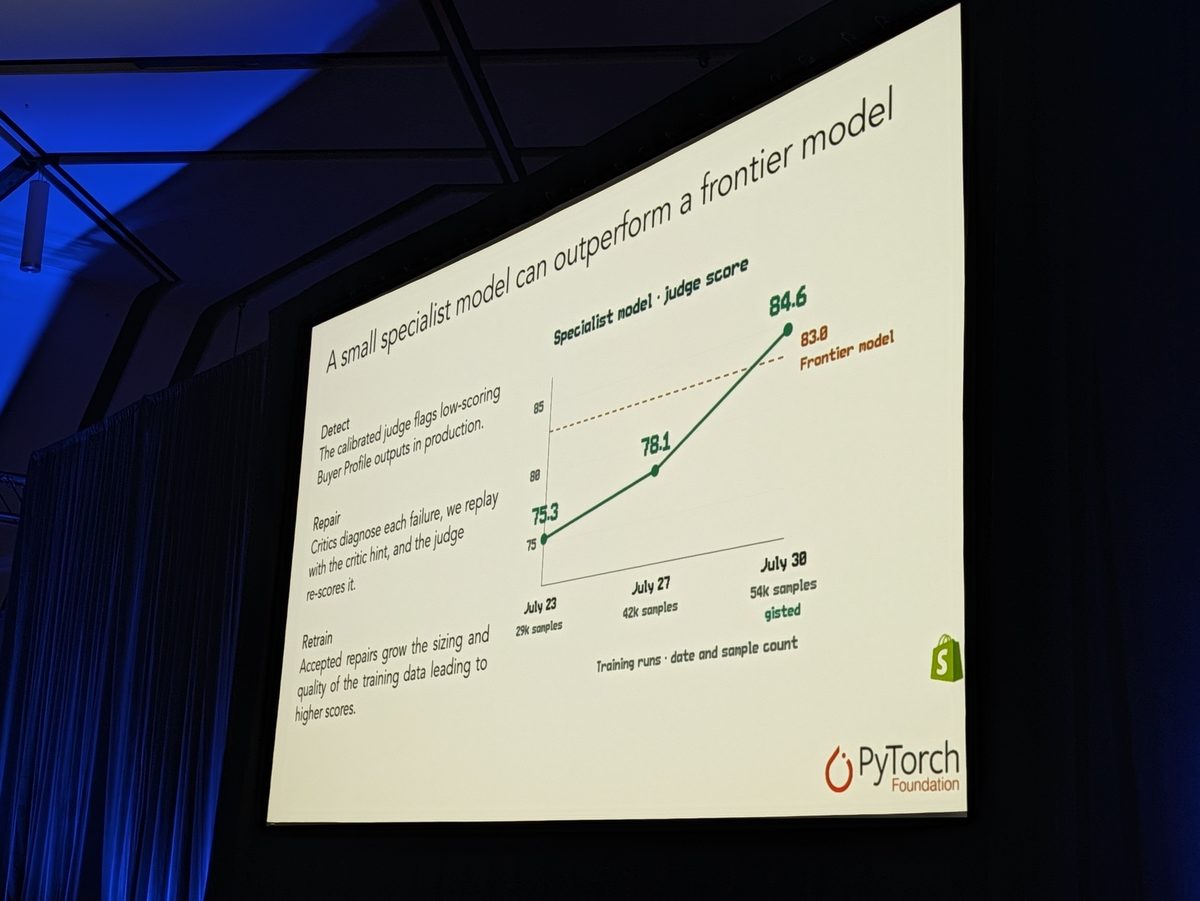
- 84.6 against 83.0: Shopify’s small specialist model against a frontier model, on the same judge.
- 2 flagship events announced for next year: San Francisco on 28 and 29 April, London on 15 and 16 September.
An open stack, kept open
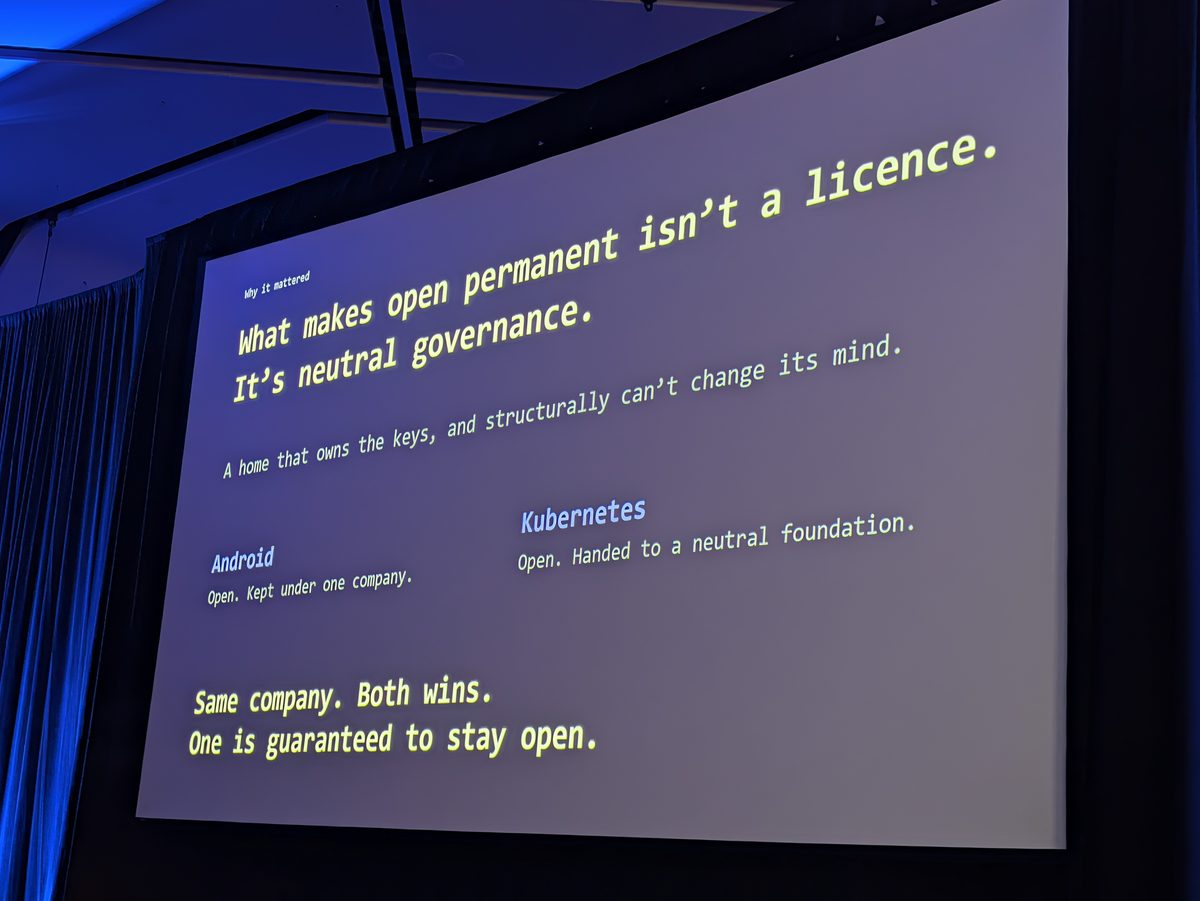
The first keynote was about the foundation itself. Mazin Gilbert, its Executive Director, called it the fastest-growing foundation in the Linux Foundation’s history, with “one member every business day”, and announced the four new projects. Manik Surtani, CTO and co-founder of the AAIF, then told the story of goose, whose community asked one question: who keeps it open? His answer, on a slide: “What makes open permanent isn’t a licence. It’s neutral governance.” Android stayed open under one company; Kubernetes was handed to a neutral foundation. “Same company. Both wins. One is guaranteed to stay open.” Later that morning Agent Skills, from Anthropic, joined the foundation.
On day two, Angie Jones, VP of Developer Experience at the foundation, took on the obvious objection in her interview: “Sometimes people will joke and say, oh, another standard.” Buying online is solved for people, she said, but not for an agent paying on your behalf; and testing a system that is not deterministic takes evals, environments such as OpenEnv, and guardrails. Her example of a standard that worked was AGENTS.md: developers wanted one file for their agent’s guidance, read by every client, and according to her the Claude team listened and decided to support it. The foundation counts 140 ambassadors and about 100 chapters, and its ten projects are open to contributors.
MCP grows up
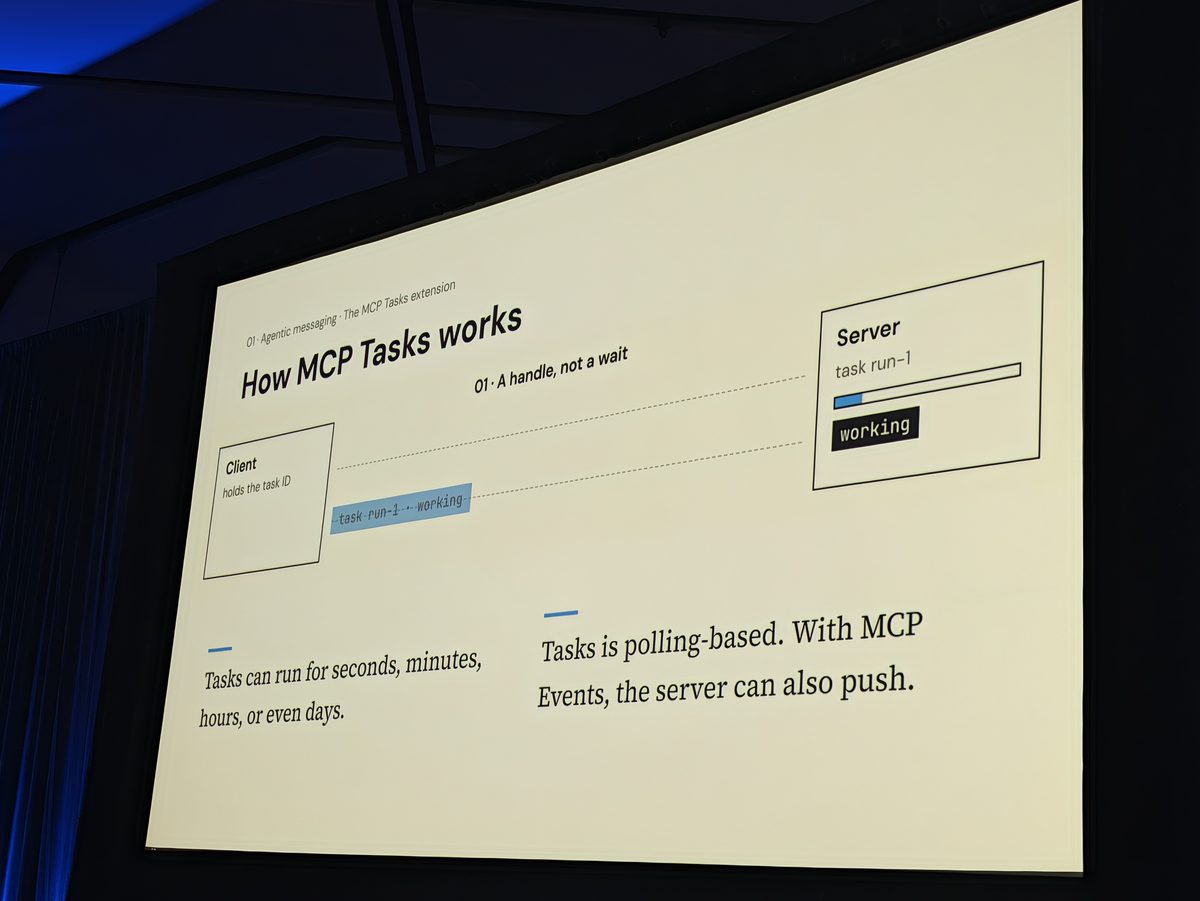
David Soria Parra, co-creator of MCP at Anthropic, gave the talk of day one. He counted 2 billion MCP tool calls in Claude, “and this amount is just growing”. His roadmap had five priority areas, and the headline was MCP Tasks: a tool call no longer has to finish in the 10 to 30 seconds most platforms allow, “you can now run them for minutes, hours, and even days”. His slide called a task “a handle, not a wait”, and it worked in Claude Code that same day. Skills over MCP came next, skills served by the server and “bound to your login”, then elicitation, the server asking the human a question in the middle of an action. “Who is using elicitations in MCP? Very few.”
On day two, Kelly Fang, Member of Technical Staff at Anthropic, showed the curve: 16x in weekly MCP tool calls since April. “Build one server. Reach people wherever they use Claude”: the same server works in Claude, Claude Code, Claude Managed Agents, Claude Tag and Claude Duet, and the Claude directory lists more than 6,000. Three builders gave their own numbers. Atlassian’s MCP grew 15x in six months, to more than 15M daily tool calls. monday.com’s Claude connector grew from 2,000 to 85,000 accounts in eight months. At Linear, this year, issues created through MCP increased 30x.
Growth has a cost, and the maintainers said so at the media and analyst roundtable on day one. “Any useful agent will talk to your back-end. So the traffic pressure on your back-end API is going to increase,” one of them said. For organisations that cannot afford a mistake, another said: deny everything by default, and allowlist.
Better systems, not only bigger models
The second day’s keynotes moved from protocols to the systems around the models. Jonathan Bryce, Executive Director of Cloud & Infrastructure at the Linux Foundation, made the case for small models with Shopify’s loop: detect the weak outputs in production, repair them with critics, retrain. Its specialist model went from 75.3 to 84.6 on the judge’s score, past a frontier model’s 83.0. The PyTorch Foundation now has six projects: PyTorch, vLLM, DeepSpeed, Ray, Helion and Safetensors. In his interview he put the pressure plainly: “I think that there’s no premature optimization happening in AI right now.”
Shadaj Laddad, of AWS, answered unpredictable agents with universal properties, “specifications that apply to any application, no matter the logic”, and two projects built on them, Hydro and Infinity. His conclusion: “universal properties bring predictable guarantees to unpredictable agents.” Rao Surapaneni, of Google Cloud, gave technology leaders a test, “Can you run a swap drill in under 2 days?”, for a model, a harness and an agent, and six best practices that ended with “evals for everything”. Chi Wang, of Google DeepMind, introduced DotSpace, “a new kind of network for people and their agents”. And on day one J.R. Storment, Executive Director of the Tokenomics Foundation, had asked the hall: “How many of you know what your agents are costing you right now?” A few hands went up. His slide’s advice: “Don’t count tokens.”
The first awards
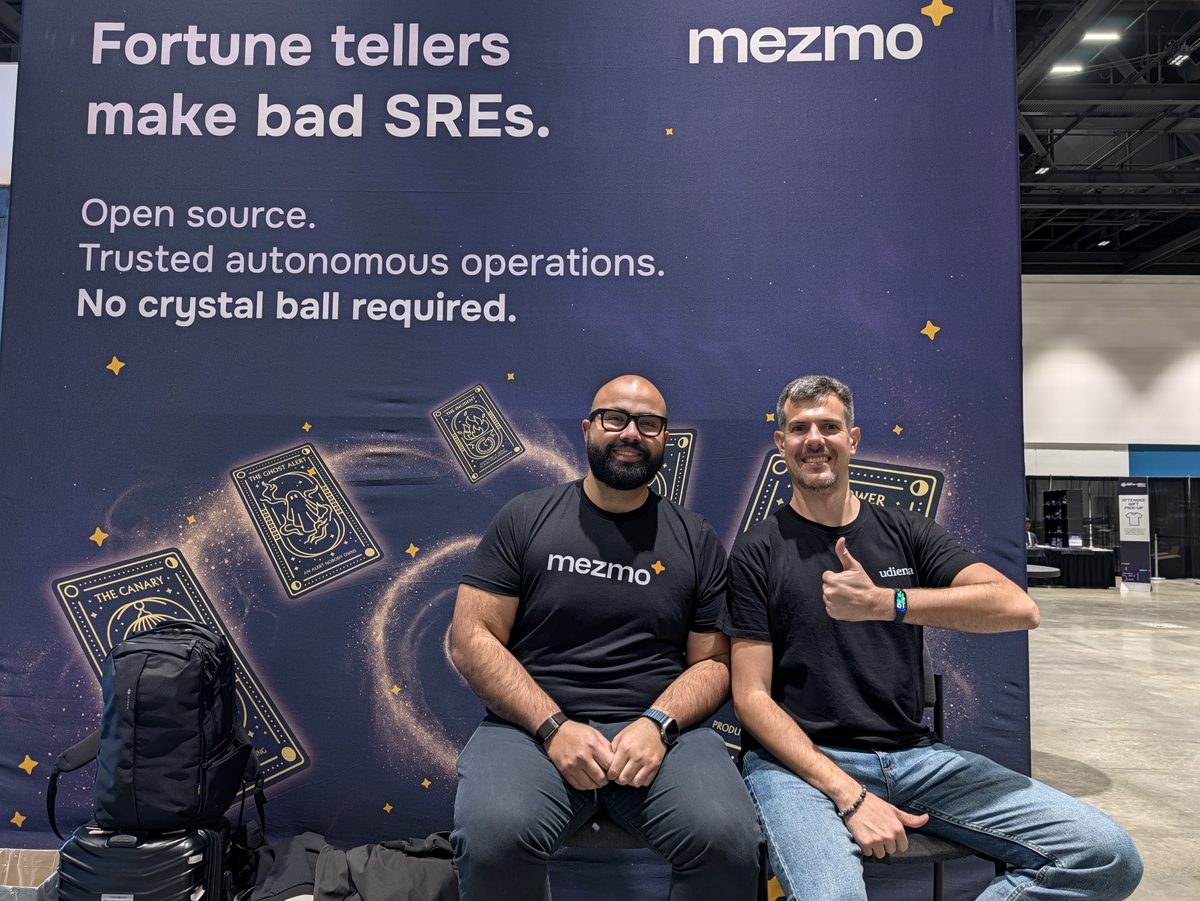
Mazin Gilbert opened day two with the AAIF Technical Excellence Awards 2026, the foundation’s first: the Keystone Award, “our highest technical honor”, and awards for Outstanding Technical Contribution, Community Builder and Open Agentic AI Innovation. The Open Agentic AI Innovation slide named Mezmo, for AURA, Opaque Systems and Vstorm, and just over an hour later Andre Elizondo confirmed Mezmo’s win at its booth.
On the floor: control, identity, context
At the booths, one word came back in nearly every conversation: control.
- Where it runs. For Lena Hall of Akamai, “control means locality”: data that cannot leave a site, and requests routed to the compute nearest the user.
- Who the agent is. WSO2’s Agent Manager, which Rania Khalaf presented, gives every agent an identity of its own, a guarded perimeter and continuous evals, what she calls “the agent halo”: “People think control might slow you down.” Nathan Slavik of Arcade.dev lets an agent act for a user, “nothing more, nothing less”. Mark Fussell of Diagrid signs every step an agent takes, because logs “can still be tampered with”.
- What it may do. Spencer Reagan of Airia fills “that negative space with blockers and barriers” around what an agent is supposed to do. Tyler Lamparter of Celigo lets workflows earn their way from deterministic to autonomous: “you earn your right to make your deterministic flows more autonomous over time”. Sanford Redlich of Alterion called agents “a third kind of entity”: unpredictable, and very fast, software.
- What went wrong. Andre Elizondo’s AURA, open sourced by Mezmo, puts a strict human in the loop before any remediation: “you don’t want to be guessing in production.” Kashish Hora of AgentCat looks for the silent failures, when an agent calls the wrong tool correctly: “All 200s, no errors happen.”
The other word was context. Hari Krishna Sunder of YugabyteDB showed Meko, “an agent context layer”. Matt Meeboer of Safe Software is “connecting any data source to any agent using MCPs”. For Sean Knight of SaturnDocs, “the people who will primarily be consuming your docs are not people.” Software itself is becoming a factory: Daniel Hoang of Akuity has agents build Kargo pipelines, Yuval Hazaz of Overcut takes a ticket from the backlog almost to production, where “maybe just a human will merge it”, and Jacek Migdał of Quesma measures what agentic coding is worth. Katherine Druckman of JetBrains, in the last interview of the conference, named the cost that stays: generating code got cheap, “But the cost of reviewing it has not, the cost of understanding it, the cost of trusting it.”
In front of the Udienza cameras
Day one, nine conversations:
- Siddarth Shekhar, San Jose State University;
- Lena Hall, Akamai;
- Michael Levan, Solo.io;
- Matt DeBergalis, Apollo GraphQL;
- Daniel Hoang, Akuity;
- Rania Khalaf, WSO2;
- Nathan Slavik, Arcade.dev;
- Yuval Hazaz, Overcut;
- Sean Knight, SaturnDocs.
Day two, thirteen:
- Jonathan Bryce, Linux Foundation;
- Andre Elizondo, Mezmo;
- Jacek Migdał, Quesma;
- Hari Krishna Sunder, YugabyteDB;
- Kashish Hora, AgentCat;
- Mark Fussell, Diagrid;
- Spencer Reagan, Airia;
- Tyler Lamparter, Celigo;
- Sanford Redlich, Alterion;
- Matt Meeboer, Safe Software;
- Angie Jones, Agentic AI Foundation;
- San Ramani, MobilityeCommerce;
- Katherine Druckman, JetBrains.
They will be published as episodes over the coming weeks.
What comes next
The foundation announced its next two flagship events: AGNTCon + MCPCon in San Francisco on 28 and 29 April, and in London on 15 and 16 September. Until then, the details are in day one, with the keynote and the maintainer roundtable, and in day two, with the awards and the afternoon’s interviews.
Built something the rest of us run on? Being a guest is free. Take the other chair
The episodes in this article
All episodes →-
Episode 06 · 7 Oct
Manik Surtani: How goose led to the AAIF