Coming soon 4:34 Recorded at Techorama Netherlands 2026, Utrecht
How do you get a school's timetable into everyone's own calendar?
Smartersoft
Stephan van Rooij of Smartersoft on putting school schedules into every teacher's digital calendar, scaling on Azure with message queues, and testing security.
Stephan van Rooij, Software architect, Smartersoft · with  Luca Berton
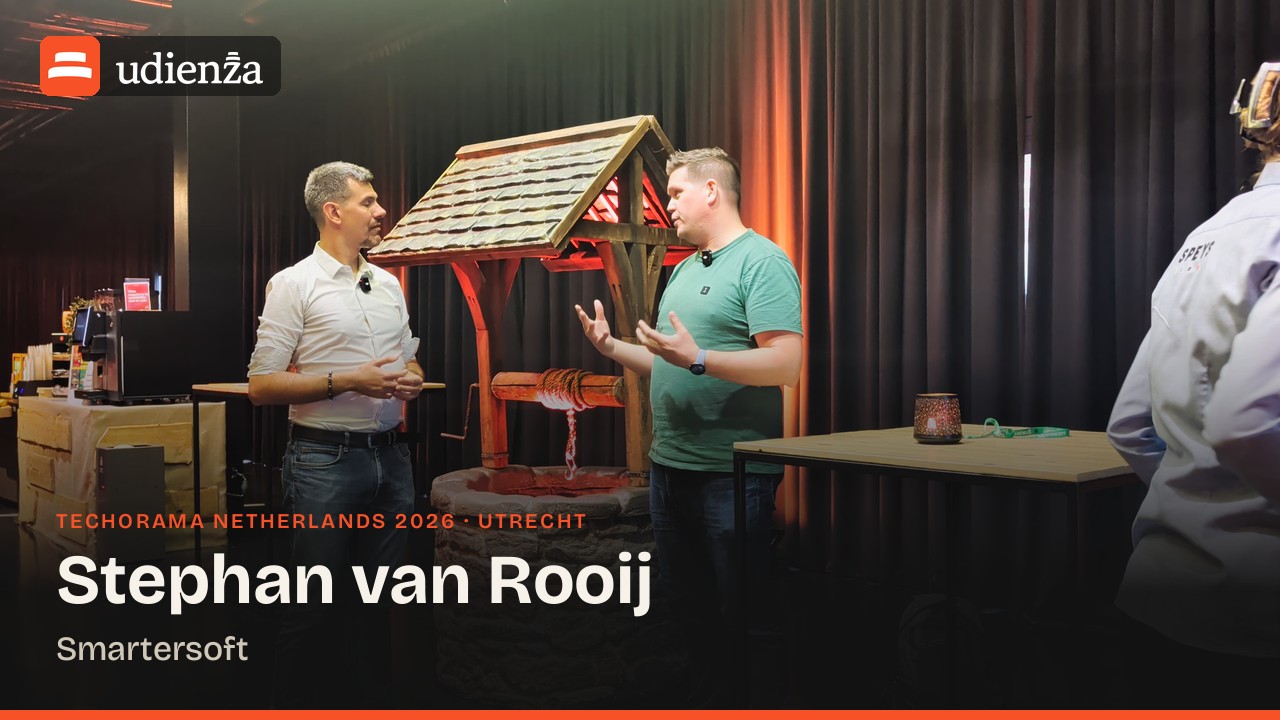
Not filmed yet.
Stephan van Rooij, a software architect at Smartersoft, started his own company by accident at university, and is a Microsoft MVP in security.
Follow the show and the episode arrives the morning it's published.
In brief
- At university Stephan accidentally started his own company: its software takes school schedules and puts them in everybody's digital calendar.
- For a few years it has been his full-time job; around 200 schools use it, from schools with 100 teachers to schools with 2,000.
- It is built on message queues and events: schedule changes are processed in separate queues, and Docker containers scale up with the messages and back to zero when done.
- Behind it are Azure Functions and Service Bus.
- A school signs up through roostersync.nl, "the Dutch for Schedule Sync", and the team arranges and configures everything.
- He urges developers to test role-based access control and to check automatically that no endpoint goes live without authentication; that work made him a Microsoft MVP in security.
- He expects to speak at more conferences, because security is going to be more important than ever, with AI finding leaks you did not know existed.
- He is on LinkedIn, and his blog has articles on security and home automation.
Chapters
- 0:00 School schedules in every calendar
- 0:44 200 schools and growing
- 1:20 Scaling with queues on Azure
- 2:43 Security, more than ever
- 3:22 Speaking at more conferences
- 3:58 Where to find Stephan
Why this conversation
Every school has a timetable, and every teacher has a calendar on their phone. Stephan van Rooij built the bridge between the two, starting at university. The host recorded with him at Techorama Netherlands 2026 in Utrecht on 27 October 2026, where they talked about a service that grew into his full-time job, how it scales, and why he now spends so much time on security.
School schedules in every calendar
“In university, I accidentally started my own company”, Stephan said. What it does is take school schedules and put them in everybody’s digital calendar: “math Wednesday from 9 to 10, English from 10 to 11”. Each person’s own schedule, in their personal calendar.
“It is growing fast. We have so many customers, so many teachers that are being helped with this software”, and for a few years it has been his full-time job. He counts around 200 schools, from schools with 100 teachers to schools with 2,000 and everything in between: “a multitude of many thousands of teachers that are helped by my software”. Roughly half a million users, the host suggested: “You could say that, yes.”
Scaling with queues on Azure
How does he manage that scale? “It is all built using message queues, events.” Changes to a schedule come in and are picked up by the queuing system, which makes the changes in separate queues, each processed separately. If the number of messages in a queue goes up, more Docker containers start automatically, and the count goes back to zero when the work is done. Behind it are Azure Functions and Service Bus. The host summed it up: everything managed by Azure Functions, “so it’s super scalable”. “Yes, exactly.”
To come on board, a school makes a contract. The website is roostersync.nl, “the Dutch for Schedule Sync”. A school can make an appointment, and the team arranges and configures everything, “and then they are in the system.”
Security, more than ever
Next to that, Stephan does a lot about security: “Security is more important than ever. You cannot imagine how important security is.” His team is putting a very big effort into more security, and he tries to convince other developers to do more in their own applications: how to test role-based access control, and how to test automatically that an application will not go live with endpoints that do not require authentication. “And that is how they made me a Microsoft MVP in security”, he said, because they like him telling the community about it.
Speaking at more conferences
For the future, he sees himself speaking at more conferences, because security is going to matter more than ever, “with AI figuring out leaks you didn’t even know existed”. “I see me giving more talks about this and helping others make their software more secure.”
Where to find Stephan
He is on LinkedIn as Stephan van Rooij, and “I also have a blog where I post various articles on security and home automation stuff.”
When it comes out
The episode is edited and in the release order. Like every episode it goes out on YouTube first, then on Apple Podcasts, Spotify and Amazon Music.
Mentioned in this episode
About Stephan van Rooij
Stephan van Rooij, a software architect at Smartersoft, started his own company by accident at university, and is a Microsoft MVP in security.
Running this in production? Luca Berton helps platform teams take it from prototype to reliable production. See how he works
Built something the rest of us run on? Being a guest is free. Take the other chair
More episodes
All episodes →-
Episode 87 · Coming
Max Katz: Avalonia UI
-
Episode 91 · Coming
Max Körbächer: Breakfast before the keynote
-
Episode 86 · Coming
Luise Freese: From AI Prototype to Production
-
Episode 84 · Coming
Lin Sun: AI agents as microservices, but more