Coming soon 5:39 Recorded at Techorama Netherlands 2026, Utrecht
Can one code base give you the same UI on every platform?
Avalonia UI
Max Katz of Avalonia UI on one pixel-perfect UI for Windows, Linux and macOS from a single .NET code base, and why one code base suits AI agents too.
Max Katz, Software Developer, Avalonia UI · with  Luca Berton
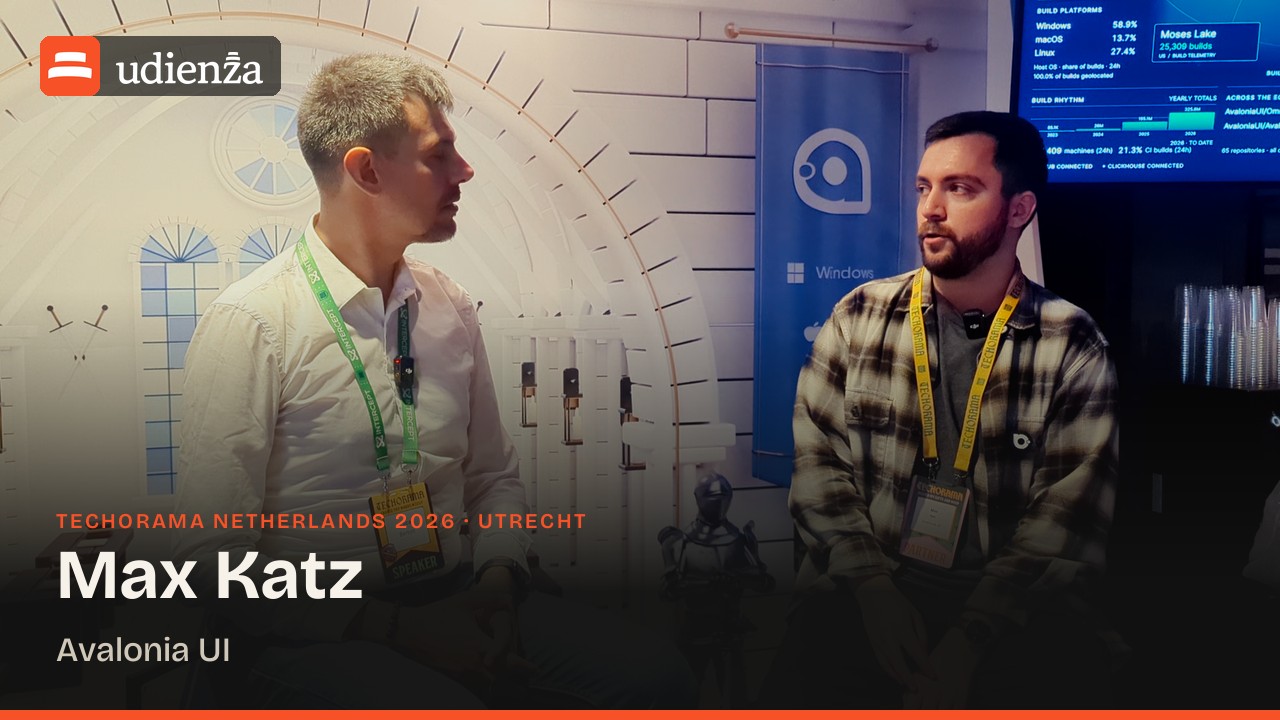
Not filmed yet.
Max Katz is a software developer at Avalonia UI, the team behind the open-source desktop and mobile framework for .NET developers.
Follow the show and the episode arrives the morning it's published.
In brief
- Avalonia UI is a desktop and mobile framework: one pixel-perfect UI, so an application written on Windows works and looks the same on Linux and macOS.
- Teams that prefer it can define different styles for each platform and use platform-specific features, while keeping one code base in one language.
- One code base is also easier for an AI agent to work on, improve and test once, with unit tests or end-to-end UI tests.
- Avalonia is open source, on GitHub, with documentation and quick-start guides; a new application usually starts from the Avalonia templates on NuGet, as with other .NET templates.
- On the roadmap: a wider ecosystem, more tooling and better IDE integration, and new controls.
- The framework is free; Avalonia sells additional controls for advanced cases such as a PDF viewer or rich text editing, next to a large ecosystem of third-party controls.
- It focuses on .NET, and is optimised for desktop business applications with complex UIs; it also runs on mobile, where UIs tend to be simpler.
- The website is avaloniaui.net and the documentation is at docs.avaloniaui.net.
Chapters
- 0:00 One UI for desktop and mobile
- 1:12 One code base for AI agents
- 1:31 Getting started with Avalonia
- 2:12 Roadmap: tooling and paid controls
- 3:15 .NET first
- 3:39 Complex business UIs
- 5:09 The website and the docs
Why this conversation
An application that has to run on Windows, Linux and macOS usually means several code bases, several teams, and the same feature tested again on each. The host stopped at the Avalonia UI booth at Techorama Netherlands 2026 in Utrecht on 27 October 2026 and asked Max Katz what they are doing there. His answer was one UI, one code base and one language, and an argument for why that matters more now that AI agents write code too.
One UI for desktop and mobile
“We develop a desktop and mobile framework for the developers”, Max said, so that you can have a single pixel-perfect UI “and reduce your headache when you write and test it”. Write it on Windows and you can be sure that Linux and macOS will work exactly as well and look the same, if that is what you want.
If it is not, you can define different styles for different platforms. There are integrations for each platform, so an application can use features specific to Linux or macOS while everything stays in a single code base, developed in a single language. That reduces the need for several developers with different backgrounds.
One code base for AI agents
Max added a reason that belongs to the present: “in the modern age of AI, it’s also way easier to have an agent to work on a single codebase, improve it, test it once with your unit tests or maybe end-to-end UI tests”.
Getting started
Avalonia is an open-source framework. It is on GitHub, with documentation and a website with quick-start guides. For a first, simple application you would typically start from the Avalonia templates, which are available from NuGet, “as typically goes with .NET applications, .NET templates”. “So you install Avalonia templates”, run the application, “and your application is running. And then you can go ahead and write your awesome apps.”
The roadmap
“We are now working on expanding our ecosystem”: more tooling, better IDE integration and some experimental products. “And also, we are working on new controls.” Avalonia itself is free and open source; the company sells some additional controls for more advanced use cases, “for example, PDF viewer or, let’s say, rich text editing”. Around them is a large ecosystem of third-party controls, which anyone can extend, or add their own to share.
.NET first, and complex UIs
Does it support other programming languages? “We focus on .NET”, Max said. Some projects and tools reach into other ecosystems, but it is primarily .NET.
Its targets are business applications with complex UIs. Asked whether rendering can be optimised for parts of the screen that refresh independently, he answered: “Of course.” Avalonia is primarily optimised for desktop, where applications have very complex trees. It can be used on mobile too, where the UI will most likely be much simpler, built around scrolling.
Where to start
The main website is avaloniaui.net, and the documentation is at docs.avaloniaui.net. The host closed by proposing to build the software of tomorrow in Avalonia.
When it comes out
The episode is edited and in the release order. Like every episode it goes out on YouTube first, then on Apple Podcasts, Spotify and Amazon Music.
Mentioned in this episode
About Max Katz
Max Katz is a software developer at Avalonia UI, the team behind the open-source desktop and mobile framework for .NET developers.
Running this in production? Luca Berton helps platform teams take it from prototype to reliable production. See how he works
Built something the rest of us run on? Being a guest is free. Take the other chair
More episodes
All episodes →-
Episode 86 · Coming
Luise Freese: From AI Prototype to Production
-
Episode 88 · Coming
Stephan van Rooij: Smartersoft
-
Episode 81 · Coming
Katherine Druckman: The human part of AI development
-
Episode 102 · Coming
Benoit Schipper: OpenCommit, a forge in Europe