4 min read
PyTorch Foundation: the brain behind agents
Jonathan Bryce of the Linux Foundation on PyTorch and vLLM as the brain behind agents, inference on Kubernetes, and why nothing in AI is optimised too early.
By  Luca Berton
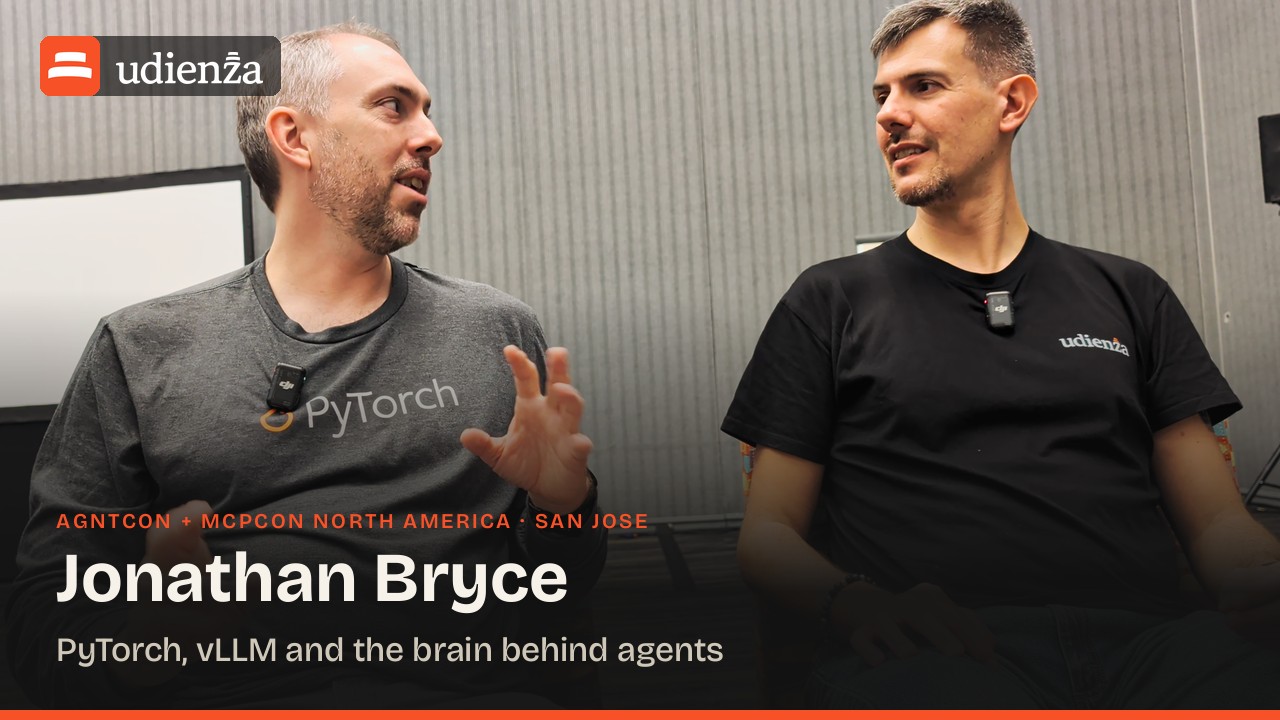
Jonathan Bryce is Executive Director of Cloud & Infrastructure at the Linux Foundation. That morning he had given the PyTorch Foundation’s keynote at AGNTCon + MCPCon North America 2026, and Luca Berton talked to him straight after, in San Jose on 23 October 2026, still in his PyTorch t-shirt.
The brain behind the agents
“AI is two letters, but it’s many, many things at the end of the day.” At AGNTCon the talk is of agents, harnesses and the interaction layer on top. “But all of that depends on intelligence.” Agents are consumers of tokens, of models, and the PyTorch Foundation is where the open source projects live that are used to create and serve those models: “it’s the brain for the agent.”
The foundation has six projects: PyTorch, vLLM, Ray, DeepSpeed, Helion and Safetensors. The two that matter most for creating that brain are PyTorch and vLLM. PyTorch is the framework where you build the pipelines, “shove all the data in, and you get a model out the other side”. vLLM is the inference engine: once you have a model, you load it on a GPU, and vLLM takes the requests and returns the answers. Together they are, for him, “the deepest technology from the AI stack.”
Inference on Kubernetes
He is also involved with the Cloud Native Computing Foundation, home of Kubernetes, and there he sees people running PyTorch and vLLM in clusters. Inference is distributed, and training runs are often extremely distributed “because of just the massive amount of data that you’re sifting through at that stage”, so teams use cloud native frameworks to orchestrate those workflows.
Luca raised the next challenge, spinning agents up fast, with projects such as kagent. A whole new set of solutions is being built around spinning up agents in a sandbox and containing them in the right environment, and Kubernetes itself is changing at its core for those workloads. At the PyTorch Conference that week, people from Google, Red Hat and IBM showed vLLM distributed across GPUs and TPUs, serving a thousand agents in a cloud native environment, with distributed inference and “incredibly efficient caching”.
From chatbots to agents
The PyTorch project has been around for seven or eight years, advancing rapidly the whole time. What changed in the last year or so is adoption, which is exploding into completely new use cases. For a long time AI was in chatbot mode: a prompt, a response, and prompt engineering on top. Now, “I tell my agent a goal I want to accomplish. And it’s hitting the LLM hundreds, even thousands of times”, spinning off sub-agents that browse the web, write code and do some math.
Pointed at commercial frontier models, paid by the token, that adds up to a lot of tokens. In the enterprise, with millions of interactions in front of customers, it has to become efficient: for speed, for cost, for the quality of the result. For a long time the cutting edge was the model layer, PyTorch, vLLM and Ray; now it is everything built around the agents as well.
No premature optimization
Software engineering warns against premature optimization, polishing code for users you don’t have yet. “I think that there’s no premature optimization happening in AI right now.” The adoption curve “has just gone vertical”, and the limit is not lines of code or servers but “constraints in the physical world of power and data center space”. “We actually can’t build, buy, and put GPUs online as fast as the demand right now.” So software is “actually getting us more capacity from the same physical footprint in the real world right now”, with efficiencies found at every layer.
Experts, more than ever
Luca brought up a conversation with Tim O’Reilly about the role of the expert when intelligence is abundant. Jonathan’s answer: the jobs predicted to disappear over the last two years have more roles than ever, and more demand for experienced, knowledgeable software engineers. The employment cycle is being disrupted, as it was by the internet; but if each person is more productive, “you don’t want fewer people, you want more people”.
What is not clear yet is the picture in five or ten years, and he expects the change at the start of careers. When he started in software in the 1990s, the focus was low-level computer engineering; the internet brought higher-level languages and frameworks, and education took time to follow. With agents writing most of the code, expertise is no longer knowing a language’s syntax. It is “do I know how to break a problem down and give good guidance on what the true outcome is?” Tell an agent something slightly off, and it will go “boof, I did it”.
More
The episode with Jonathan Bryce is being produced and goes out on YouTube first. His keynote and the rest of the day: AGNTCon + MCPCon North America 2026: day two.
Built something the rest of us run on? Being a guest is free. Take the other chair
The episodes in this article
All episodes →-
Episode 69 · Coming
Jonathan Bryce: PyTorch, vLLM and the brain behind agents