3 min read
Overcut: a software factory run by agents
Yuval Hazaz, co-founder and CEO of Overcut, on running autonomous agents across the software lifecycle, and why the dark factory will come gradually.
By  Luca Berton
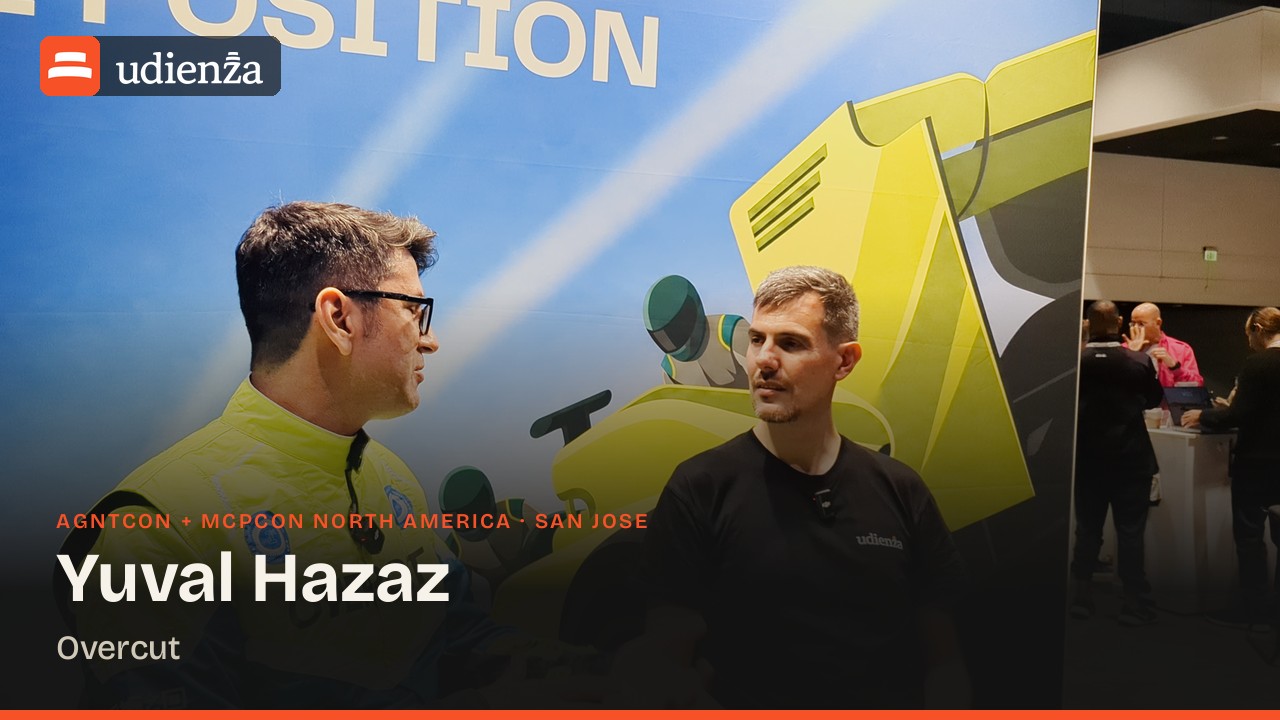
Yuval Hazaz is co-founder and CEO of Overcut. Luca Berton talked to him at the Overcut booth at AGNTCon + MCPCon North America 2026 in San Jose on 22 October 2026. Luca opened by thanking him for the pole position; Yuval welcomed him to the pit stop.
The name
An overcut is a Formula One strategy: it decides when a car makes its pit stop. The name came through his daughter, a Formula One fan, and it fits the company’s idea of winning by bringing the best result. Overcut is the name of its software factory, which is why the team was at the booth in uniform.
A software factory
“Software factory is a way for organizations to run autonomous agents on top of their software development lifecycle.” As in Formula One, almost every team has the same engine, which here is the model; the teams that win do it through orchestration, teamwork and strategy. That is what Overcut lets organisations build.
The whole stack, in a loop
Luca asked how that works in a stack with so many moving parts: the harness, MCP, composability. Overcut manages all of it:
- building the agent, and connecting MCP servers and skills;
- workflows that mix deterministic and non-deterministic steps;
- the sandboxing and the execution of those workflows;
- monitoring, logs and audit trails, which are then used to improve the workflows and to create memories.
“So in that way, you have a loop of a self-improving software factory.” Overcut does the triggering, gets the signals, decides what to run, runs it, monitors it, and fixes and improves it for the next time.
What customers run
The biggest use case is spec to code: a ticket taken from the backlog almost all the way to production. “Maybe just a human will merge it when you’re ready.” Many customers also run root cause analysis, code review and the validation of code review, documentation updates and testing.
Overcut is not tied to an industry, and it does not bring its own opinion of how those jobs should be done. Customers build their own versions by talking to Overcut, so one customer’s code review or root cause analysis differs from another’s. Overcut provides the infrastructure and the platform.
Getting started
You sign up at overcut.ai. Larger organisations get a white-glove onboarding and a pilot, with help building the workflows and integrating them. Overcut also runs on premises and in private clouds; regulated organisations usually run the whole stack in their own VPC. Once you have access, you connect GitHub and Jira and start configuring workflows.
The dark factory
Today’s software factory still has a human in it, supervising. The dark factory, people say, would “turn the light off”: nobody inside, an intent in and a product out. Yuval believes it will happen, “but probably not in the next 12, 18 months.” Legacy enterprises and large regulated organisations are not ready for it, so it will come gradually, as the models advance and as organisations get their infrastructure ready for AI.
More
The episode with Yuval Hazaz is being produced and goes out on YouTube first. The day it was recorded: AGNTCon + MCPCon North America 2026: day one.
Built something the rest of us run on? Being a guest is free. Take the other chair
The episodes in this article
All episodes →-
Episode 67 · Coming
Yuval Hazaz: Overcut