Conversations
5 min read
OpenSearch: one data layer for AI, no silos
Bianca Lewis of the OpenSearch Software Foundation on OpenSearch as a data layer for AI: no silos, hybrid search, long-term support or fast releases.
By  Luca Berton
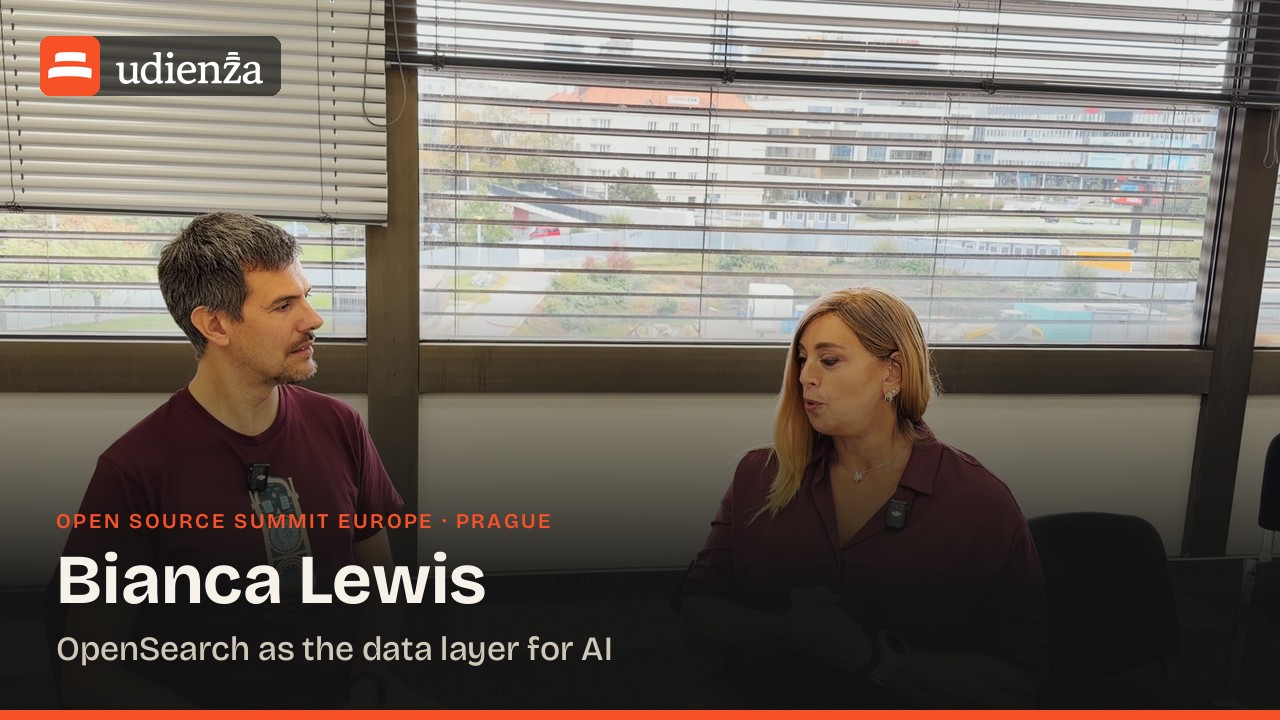
Bianca Lewis is Executive Director of the OpenSearch Software Foundation. Luca Berton talked with Bianca at Open Source Summit Europe in Prague on 9 October 2026. The conversation was about what OpenSearch has become since its start as a fork: a data infrastructure layer for AI.
From fork to independent platform
Some people still associate OpenSearch with Elasticsearch, and Bianca calls that “a really valid question”. The origin was indeed a fork, made within AWS as a start to the project, and Bianca “couldn’t think of a better home to start off the project.” It was always intended as a truly open source project, “and from day one, that was the truth.”
Two years later it was donated to the Linux Foundation, “to add the credibility that no single vendor owns OpenSearch.” The fork was five years ago. Today, Bianca says, OpenSearch is its own independent data infrastructure platform for AI, separate from any other platform on the market in look and feel, in functionality and in the way it works.
No more data silos
The foundation defines it as “an AI data infrastructure layer that runs above your physical infrastructure in a business.” In the old days, data was discussed by use case: log analytics, application monitoring, tracing, search and security monitoring, each as its own silo. The scale is different now, with LLMs and agentic AI carrying out hundreds of thousands of queries almost simultaneously. “So working in silos and paying that data tax by use case is not a scalable approach in this era.”
What is needed instead, Bianca says, is to look at all the data a business generates and mesh it together in one infrastructure layer, without seeing logging separately from application monitoring, from tracing or even from search applications.
The shoe shop
Bianca’s example is an e-commerce business selling shoes. It needs a search application that gives accurate results so customers find the right product, and that can be spun up on OpenSearch “in a few minutes”. But the shop also uses vector search, and agentic AI for its warehousing, payment and financial systems, all communicating with each other. “It’s not just looking for a shoe anymore.”
So the business has to know more than whether a customer found the shoe. How much does the search application cost to run, when the agents working on the infrastructure add load as well as the person running a query? Is it secure? Which services are the agents calling? “If I’m working in silos, my observability is not really talking to my search application.”
As an infrastructure layer, OpenSearch can take a search application, create an observability stack on top of it automatically, enrich it with cost data and add security monitoring. What you build, in Bianca’s words, is “a holistic viewpoint” for an era of scale “that you’ve never seen before.”
Why vector search shows the wrong shoes
Luca asked how this applies to agentic commerce, where a personal agent knows your taste and goes to scout for a product. Say you want brown shoes from a designer called Brand X. With pure vector semantic search, “as we were a year ago”, the vectors go to the nearest neighbours: “you’re going to see brown shoes from Brand X, you’re going to see brown shoes from Brand Y, and you’re going to see blue shoes from Brand X”. Those are results you don’t want to see.
OpenSearch uses hybrid search instead. “It’s going to lexically filter for the terms which we’re not going to vectorize straight away”, so Brand X stays Brand X, and then it applies the vector search. The search results become more relevant, and the cost of the infrastructure stays efficient. Bianca adds that the platform itself has a workbench for search relevance.
Long-term support or a release every eight weeks
Luca raised a challenge heard often at enterprise level: long-term support on one side, new capabilities and new protocols on the other. Bianca agrees they are “two opposing forces”. The answer is choice. As a vendor-neutral open source platform, OpenSearch gives its users options, and being sovereign over your data platform, “that sovereignty to me means that I have the choice.”
One choice is a long-term supported version, which “will have guaranteed support for at least 18 months”, a stable version to build on and predict on, which matters to some businesses. Others would rather update with the release cycle of every eight weeks. Either way, “they’ve got 105 vendors in the ecosystem” to help with the approach that is right for their business. Bianca describes that as a community that has built the ecosystem around the platform.
Platforms built for AI scale
Most software in the world, Bianca says, was developed before the scale AI now lets us reach: first cloud-native, then AI-native, now agentic AI-native. The modernisation of OpenSearch is a focus, and the just-released version 3.9 shows the trends: efficiency at agentic AI scale, control of cost, more accurate search results, and storing vectors more efficiently while still recalling them at speed.
The other half is usability. A few months ago, using Prometheus from OpenSearch’s observability components meant coding in an alert to be told when something happens. In the latest release, “we can literally write the alert that we want and it will generate the query for us to configure this alert on Prometheus.”
The user base is growing: 2.4 billion downloads, with 3,000 active contributors and 400 companies. Luca pointed to the pressure on data as every company builds agentic AI platforms. Bianca’s view is that AI security and AI agents are very important, “but they mean nothing unless you’ve got the data”, an infrastructure platform underneath providing the data retrieval and processing.
The business of tomorrow
What about a company built from scratch? In five years’ time, Bianca expects businesses to scale with the data infrastructure layer “driving business decisions, driving customer experiences.” There won’t be as many user interfaces: “It will be consolidated and simple to use.” Businesses can then concentrate on the systems that drive increased business for their customers, “and not the details of how they’re going to use them.”
More
The episode: Bianca Lewis. The foundation: OpenSearch Software Foundation. The week it was recorded: Open Source Summit Europe 2026: who we met.
Questions and answers
Is OpenSearch still a fork of Elasticsearch?
It began as a fork within AWS five years ago and was donated to the Linux Foundation two years later. Bianca Lewis says it has since developed into its own independent data infrastructure platform for AI, different in look, feel and functionality.
How does OpenSearch balance long-term support with fast innovation?
By giving users the choice: a long-term supported version has guaranteed support for at least 18 months, or a business can update with the release cycle every eight weeks. 105 vendors in the ecosystem can help with either approach.
Why does hybrid search give better results than pure vector search?
It filters lexically on terms it does not vectorise straight away, such as the brand, and only then applies vector search, so the results stay relevant and the infrastructure cost stays efficient at scale.
Built something the rest of us run on? Being a guest is free. Take the other chair
Related articles
All articles →-
Conversations · 2 min read
Luise Freese: AI prototypes into production
Software architect Luise Freese on her 90-day playbook for shipping enterprise AI, where agentic AI fits, and getting dev people and people people to talk.
-
Conversations · 4 min read
ownCloud: own your files, Pi to Kubernetes
Jordana Fung of ownCloud on Infinite Scale: one Go binary with no database, Apache 2.0 with nothing gated, and a company re-engaging its community.
-
Conversations · 3 min read
Edera: a micro-VM and a kernel for each workload
Kavitha Daula, VP of Engineering at Edera, on why containers sharing one kernel is a risk, zones per workload, and isolation for AI-written code.
The episodes in this article
All episodes →-
Episode 47 · 4 Nov
Bianca Lewis: OpenSearch as the data layer for AI