Conversations
5 min read
Linux Foundation: inside the stable kernel
Greg Kroah-Hartman on AI tools that find kernel bugs, why a phone runs more of Linux than a server, the CRA, students, and 35 years of maintaining.
By  Luca Berton

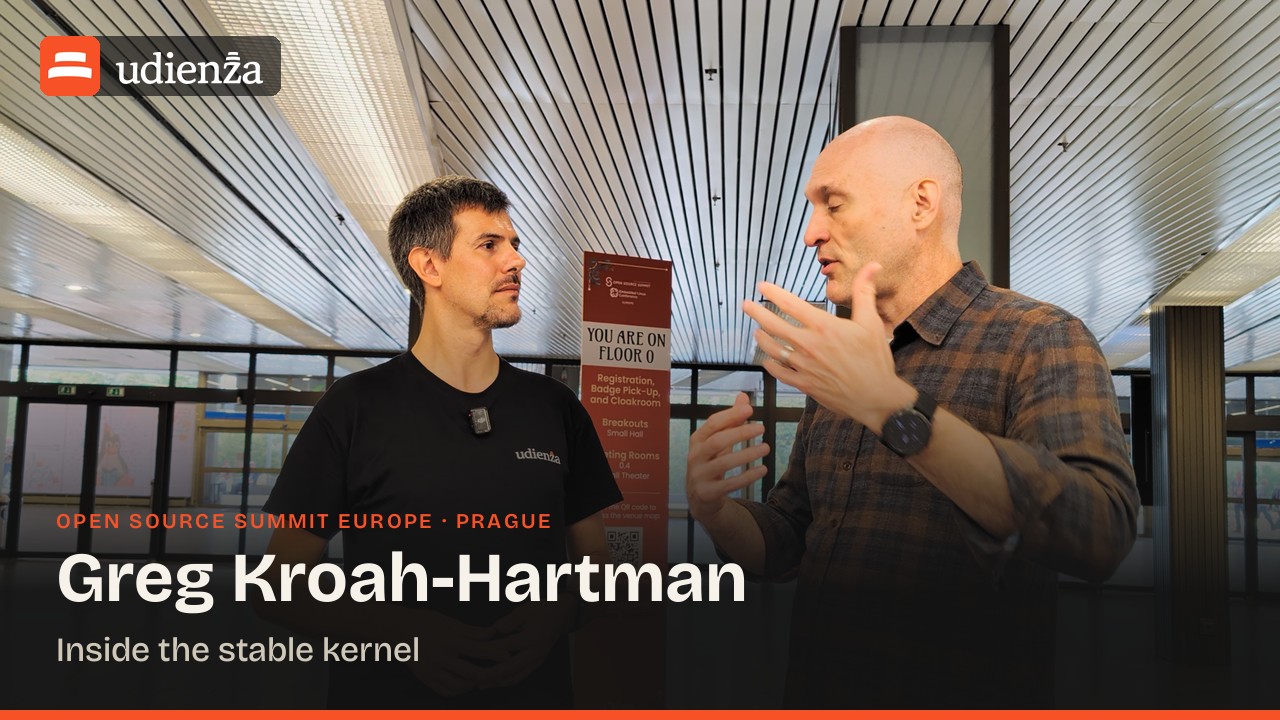
Greg Kroah-Hartman is a Linux kernel developer and maintainer at the Linux Foundation: they maintain the stable kernel trees and lots of parts of the driver core, work on the security team, and work with the EU on the CRA and other legal issues. Luca Berton talked to them at Open Source Summit Europe 2026 in Prague on 7 October 2026, on the Wednesday morning of the event.
The boring, important work
Asked what is interesting at the moment, Greg calls it boring. AI and fuzzy pattern-matching tools have found bugs in the kernel’s code, and the developers are grinding through them and fixing them. “So it’s not interesting, it’s important, but it’s just a lot of work.”
Are these zero-days? “Not really zero day, some are, but they’re small tiny bugs all along the way.” The tools are, in a way, static scanners. The easiest thing they do is take all the bugs that were fixed in the past and ask where the same mistakes are still in the code today. The tool links them up and points at the places that might be wrong.
A server is a simple machine
The kernel is 25 to 30 million lines of code, but no machine runs all of it. “Servers are very simple machines”: a disk, a network, maybe two to three million lines. A laptop runs three to four million. Phones are the most complex piece out there, at four or five million, because of all the different chips, the sensors, the graphics and the connections.
Luca, who used to work a lot with servers and AI, mentioned the models loaded at runtime. That is all user space, Greg answers. The kernel is the level that abstracts away the hardware, so a program works on a server, a Raspberry Pi or an Android device. “It doesn’t care about the hardware.” The kernel’s job is to fix the bugs in the hardware and provide that middle layer in a secure way.
RISC-V and the long design cycle
That abstraction is why RISC-V can work. “The nice thing about RISC-V is you can replace the processor and then everything that works on Linux works on RISC-V.” A RISC-V company can come out with a really good chip and compete on equal ground with everybody else. The ecosystem has growing pains getting the chips working properly, but there is now a standard, and Greg has good hope for it. Somebody emails Greg crazy CPU designs about every month, and some of them are really cool.
The kernel developers do not work with manufacturers directly, but they talk to them all the time. They have worked with Intel and AMD for decades; the companies show what is coming, and the developers tell them their pain points. They talk to Samsung, Huawei and the other chip companies too. “CPU design cycles are long”: something worked on today takes four to six years to come out. “But we’re in it for the long haul.”
The CRA and sovereignty
On policy, Greg is positive. The EU wants software and devices to be secure, and the CRA will help with that. “Basically, it’s just like an ingredients list of all the software that’s in the device.” It has to be kept up to date for all known vulnerabilities for a number of years, the same thing that is done for food or paint. The EU commissioners know open source is important, and “the requirements in the open source communities are very minimal.” The law also forces those who use the kernel and ship it to send the bug reports back, which they have not always done.
Digital sovereignty, in Greg’s view, is what Linux already gives: you can run your own server and not depend on another company. They have worked with the Dutch and French governments, and kernel people work with the German government, to show how. “We’re not forcing anybody to use Linux, but if you want to, you can.”
Students and open source
For someone entering the job market today, Greg’s selfish answer is that there is lots of kernel development work, especially in security. They work with a university in Amsterdam, and this summer gave a number of master’s students security bugs that AI had found, and did some research to see how well they worked.
The advice is to use the free time a student has to contribute to open source. At university you solve problems on your own; in the real world “you have to work with an existing code base and work well with others.” An open source track record shows an employer exactly that, and “that sets you apart from other candidates who don’t have that experience.” The kernel has taken part in Google Summer of Code since the beginning, there is an outreach programme, and the Linux Foundation has an internship programme: one of the people speaking at the event started as an intern and now speaks at conferences around the world.
Bots, Rust and static analysis
Asked about AI and Rust, Greg separates them: “Rust is independent of AI or LLMs.” LLMs, for the kernel, are static code analysis. Every change submitted to the kernel now goes through a bot that runs a set of checklists and says what might be a problem. It is public, everybody sees it, and “it’s a first step of a code review.” The community has worked on these ideas for decades, with papers, and has used them for backports to the stable kernels for 10 or 15 years.
Maintaining is the different skill
Linux has no plan for the future, Greg says: it responds to what is sent to it. “I want to see Linux keep working for everybody and that’s about it.” The development model has run for 35 years, and writing a project once is simple. “Maintaining it over a long period of time and evolving it in a way with 5,000 developers from 600 different companies, that’s a whole different skill.”
Responsibility is split among about 700 maintainers, each with an area, and “we all merge it all together every day and test it all.” Because the kernel hits pain points early, it helps other projects, such as Kubernetes when it started scaling. Greg’s favourite part of the job is finding Linux in places they did not expect: in their washing machine, in satellites, on Mars.
More
The conversation: Inside the stable kernel. The week it was recorded: Open Source Summit Europe 2026: who we met.
Questions and answers
How many lines of the Linux kernel does a machine run?
The kernel has 25 to 30 million lines of code, but no machine runs all of it: a server two to three million, a laptop three to four million, and a phone, the most complex, four to five million.
What does the CRA ask of open source communities?
Very little, says Greg Kroah-Hartman: the requirements on open source communities are minimal, and the law makes the people who ship open source send bug reports back.
How can a student get into kernel work?
By contributing to open source in their free time, and through programmes such as Google Summer of Code, outreach programmes and the Linux Foundation's internship programme.
Built something the rest of us run on? Being a guest is free. Take the other chair
Related articles
All articles →-
Conversations · 4 min read
ownCloud: own your files, Pi to Kubernetes
Jordana Fung of ownCloud on Infinite Scale: one Go binary with no database, Apache 2.0 with nothing gated, and a company re-engaging its community.
-
Conversations · 2 min read
CNCF: Istio and collaboration over competition
Faseela K, CNCF TOC member and Istio maintainer, on maintaining Istio, the CNCF ambassadors, the new CKNE exam and why collaboration beats competition.
-
Conversations · 5 min read
Red Hat: twenty years of pahole, structs to BPF
Arnaldo Carvalho de Melo of Red Hat on how pahole became part of every kernel build, BTF for Rust, and perf profiling data structures.


The episodes in this article
All episodes →-
Episode 14 · 27 Oct
Greg Kroah-Hartman: Inside the stable kernel