3 min read
JetBrains: the human part of AI development
Katherine Druckman of JetBrains on why reviewing, understanding and trusting AI-generated code still costs what it did, and the human in the loop as a person.
By  Luca Berton
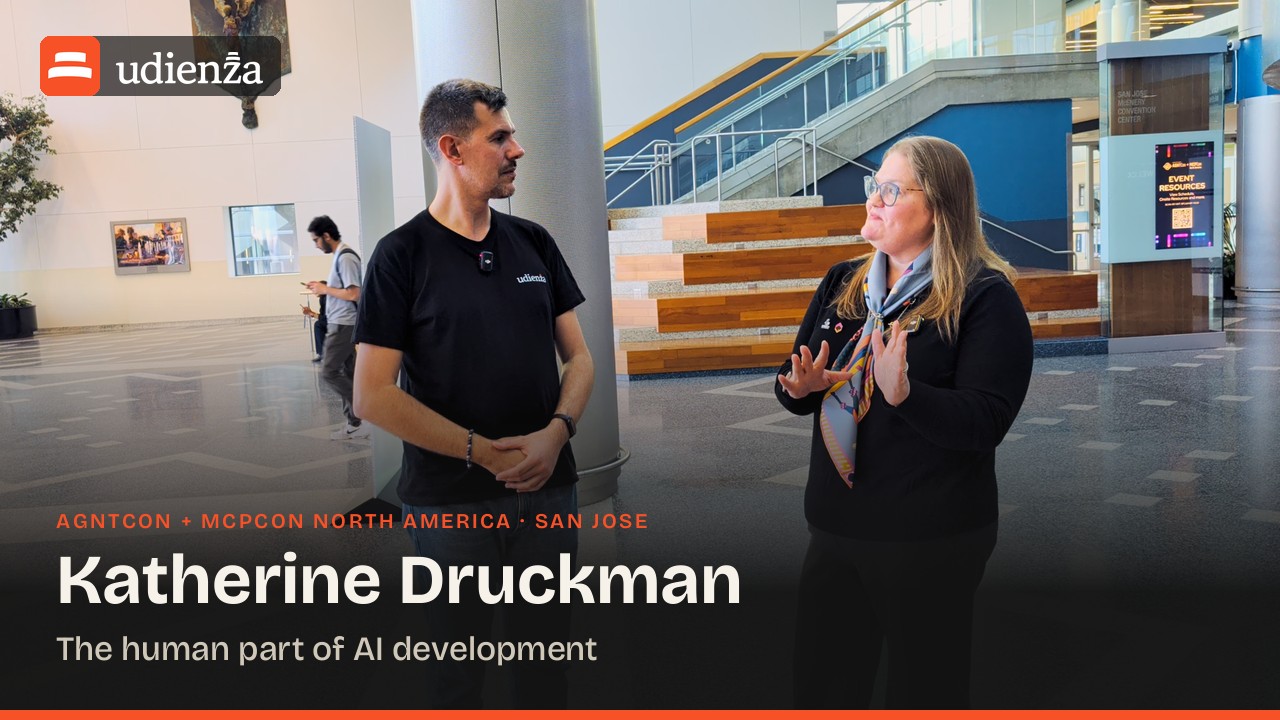
Katherine Druckman works at JetBrains. Luca Berton talked to her at AGNTCon + MCPCon North America 2026 in San Jose on 23 October 2026. It was the last interview of the conference, an hour after her talk in the open source community track, “Open Source Has Been Here Before: Sustainability Lessons for Agentic AI”.
In the open
She has been around open source communities “for a very long time. I don’t even like to count the years anymore.” She is involved in the Agentic AI Foundation, where JetBrains is a member, and in the OpenSSF, the Open Source Security Foundation, which she has been part of for a while. What interests her is the work being done in the open on these difficult problems.
What has not got cheaper
JetBrains, she says, is taking AI development very seriously, and the way it sees it, that applies to open source communities as well as to developers of all kinds.
Generating code has become cheap, in time at least. “But the cost of reviewing it has not, the cost of understanding it, the cost of trusting it.” That is what becomes more and more important. So where does the human go? Writing the code is less and less the job, “but as AI generates the code, people are still responsible for it.” They have to know what is in their software, be accountable for it, trust it and understand it. That is the position JetBrains takes: supporting developers of all kinds, in open source and everywhere else.
The human in the loop is a person
“It’s something that I get a little soapboxy about. That’s what my talk was about, actually.” The talk was about the human part of all this work, and the humans who need support.
She had a slide on human in the loop, a phrase the industry loves. People talk about it as “sort of like a safety gate or something like that. But it’s also, at the end of the day, it’s a human, an actual person.” Someone who is accountable, who needs to understand and to have a reason to make a change to a code base, and to understand the reason behind it. What does that person need? Effective tools, she says. And, going back to open source communities: resources, support and, let’s be honest, budgets, which can go towards the right place, or towards time. An open source community is people contributing their own time and understanding.
For developers who are AI-first, and those who are not
JetBrains enables the developers who work with AI first, and also those who don’t: not everybody works that way, and that cannot be taken for granted. It has just launched JetBrains Air, and at the conference it demonstrated something more experimental: a tool designed to help developers understand cost, how many tokens they spend on certain tasks, and to make what development teams learn shareable across an organisation.
The place to start is jetbrains.com, and she invites people to find her, and her colleagues at JetBrains, on social media.
More
The episode with Katherine Druckman is being produced and goes out on YouTube first. The day it was recorded: AGNTCon + MCPCon North America 2026: day two.
Built something the rest of us run on? Being a guest is free. Take the other chair
The episodes in this article
All episodes →-
Episode 81 · Coming
Katherine Druckman: The human part of AI development