3 min read
Celigo: MCP servers with governance built in
Tyler Lamparter, product manager at Celigo, on governed MCP servers for back-end systems, access down to single tools, and earned autonomy in finance.
By  Luca Berton
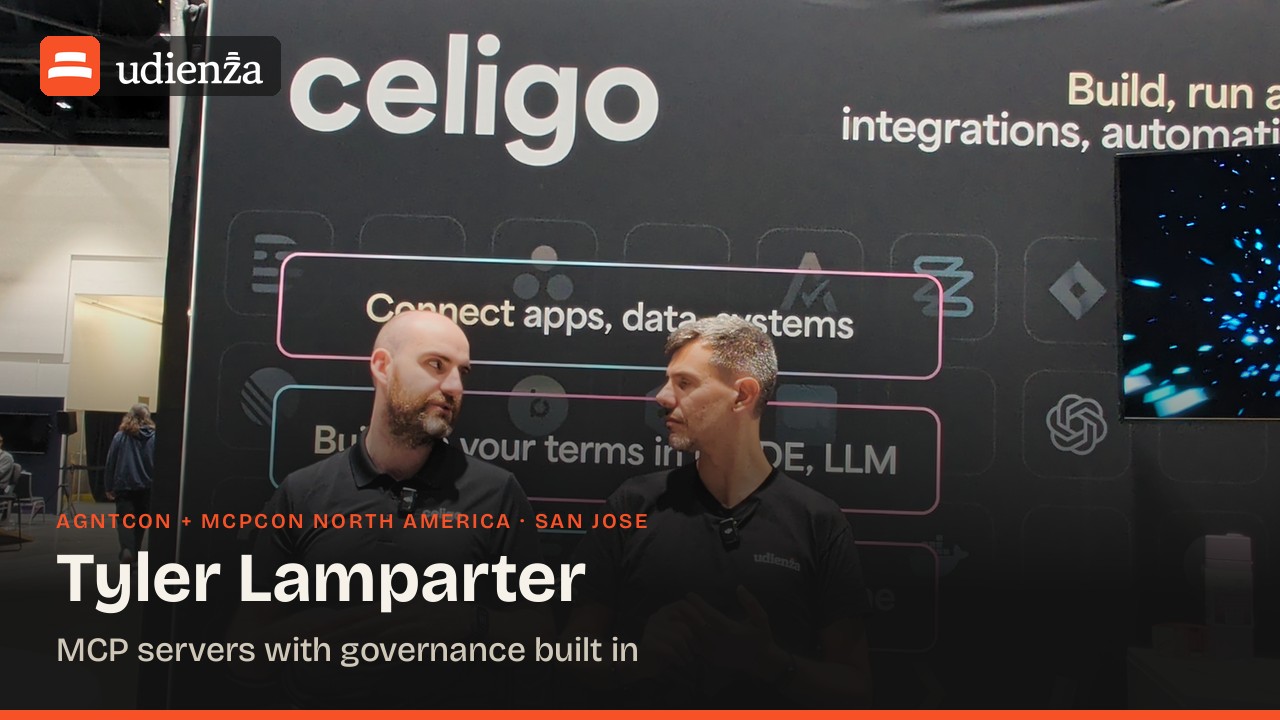
Tyler Lamparter is a product manager at Celigo. Luca Berton talked to him at AGNTCon + MCPCon North America 2026 in San Jose on 23 October 2026. Celigo is an integration platform as a service, around for more than ten years, connecting back-end systems such as ERPs and CRMs, moving their data back and forth, with connectors to thousands of enterprise applications.
From integration to agents
Agents fit that space well, he says. Celigo already had the connectivity to a company’s back-end systems, and every employee now wants their agents to reach them. “MCP is that protocol to extend that connectivity to all the agents that people have got.” So Celigo has built ways to create MCP servers in its platform, to connect to those systems securely and with governance.
Governance, not bolted on
With so many companies at the conference doing similar work, Luca asked what makes Celigo different. First, the governance layer on top, “the traceability and auditability and observability” of what happens when agents call your back-end systems, for companies with high security, compliance and governmental requirements. Second, all of it sits in “a single platform that’s not bolted on with various different acquisitions”.
Many of Celigo’s customers run e-commerce businesses on Shopify and Amazon. Tyler came from one: he joined Celigo four years ago from an e-commerce company that used it, and now works on the product side.
A proxy for MCP servers
His focus is the MCP servers, and the management layer on top of them. Customers who go to the Claude or Cursor marketplace connect directly to the vendors’ MCP servers. Through Celigo they can proxy those servers instead, adding governance “of like who’s calling what, you know, why they’re calling it”, and restricting access down to the tool level: exactly which tools of a server each user has.
Midway through the interview, staff came by to announce that the expo floor was closing.
Bring your own keys
To get started, there are sign-up forms on the website and a free trial with all the platform’s capabilities, and the team is happy to demo and even build things with you. Do you need to bring your own AI? Celigo’s platform lets you build AI agents, with your own keys or with models it hosts from providers it has contracts with. The MCP servers themselves don’t need AI: they host the tools and the connectivity, and you bring your own system keys.
Earned autonomy
The biggest use case he sees, inside Celigo and across its customers, is finance automation. Finance teams work in email inboxes, with vendors sending PDFs and requests: update the billing details, send the last invoice or receipt. AI is great, he says, but much of that work is deterministic, so you put AI only where you need it. The emails are fetched deterministically. One agent sorts them into types. Another finds the information it needs and drafts a reply, but does not send it, because a person reviews it and sends it off.
Celigo is calling the approach earned autonomy: “you earn your right to make your deterministic flows more autonomous over time.” Most of the processes it sees are fully deterministic, apart from the specific points where an agent is needed.
More
The episode with Tyler Lamparter is being produced and goes out on YouTube first. The day it was recorded: AGNTCon + MCPCon North America 2026: day two.
Built something the rest of us run on? Being a guest is free. Take the other chair
The episodes in this article
All episodes →-
Episode 76 · Coming
Tyler Lamparter: MCP servers with governance built in