3 min read
Arcade.dev: agents that act on your behalf
Nathan Slavik of Arcade.dev on authorization, enforcement and governance: a runtime that lets an agent act as you in Salesforce, Gmail or Workday, and no more.
By  Luca Berton
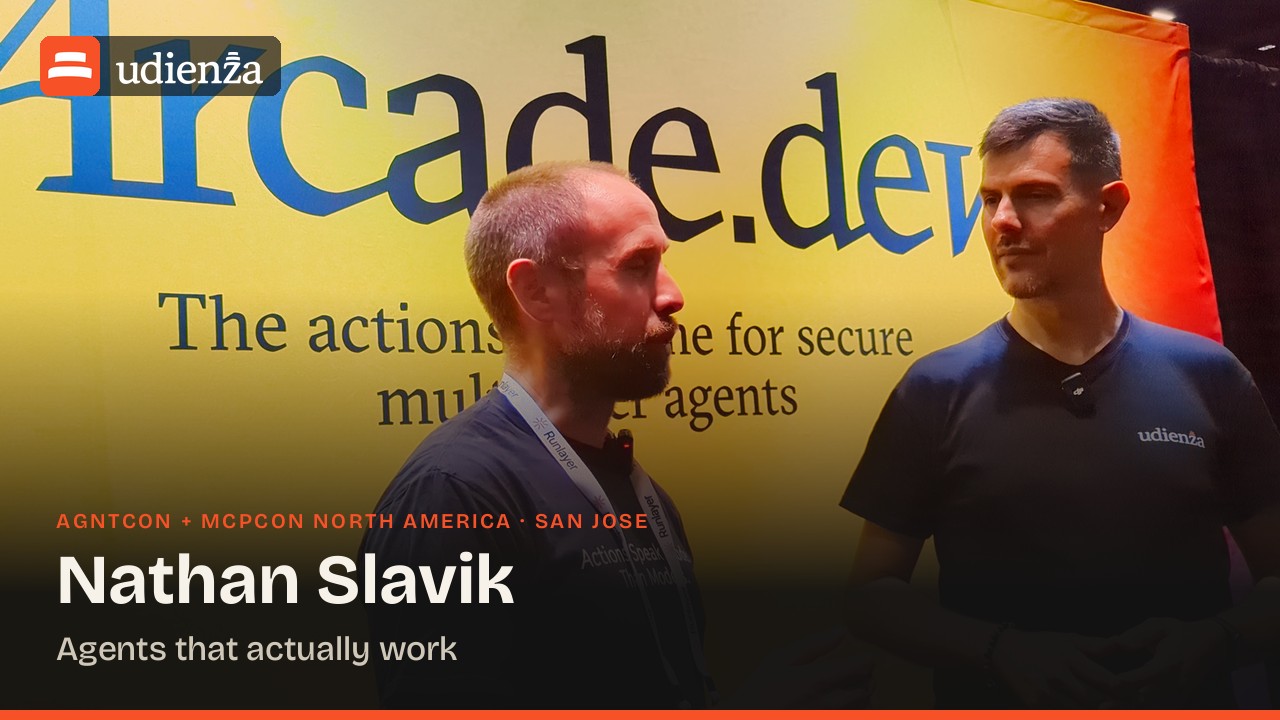
Nathan Slavik works at Arcade.dev. Luca Berton talked to him at AGNTCon + MCPCon North America 2026 in San Jose on 22 October 2026 and asked what Arcade.dev does. His one-line answer: “Arcade.dev makes agents actually work.”
Three steps
What he means by that comes in three steps.
The first is authorization. “Can this agent actually take action on behalf of this user?” If a business wants its agent to sign into Salesforce, how does it know the agent can sign in as that person?
The second is enforcement. Once the agent is in Salesforce, it should be able to do what its user can do, “nothing more, nothing less”. It should not delete a customer record if the user doesn’t allow it.
The third is governance: “a complete audit trail”. Looking back, you should be able to see which agent took which action, on behalf of whom, and when. That layer of authorization, enforcement and governance, he says, “is why large banks trust Arcade to be able to work in their systems”.
Who uses it
Like so many businesses in the industry, it starts with engineering and dev teams, and once Arcade is in their systems it spreads. Much of the traction now is with go-to-market teams, and with something that sounds simple: HR. “Most employees don’t want to log into Workday.” They want to tell their agent they will be off for a week and have it scheduled. The same questions apply: the agent has to get into Workday securely and schedule it on the employee’s behalf.
How it works
Arcade takes a company’s existing permissions and policies and translates them to its agents. Nathan used Luca and Gmail as the example. Arcade sits “as an action runtime” between the two. When Luca tells his agent to send an email, Arcade checks that it is really his agent and lets it into Gmail; when the agent sends, that goes back through Arcade, which checks that it can. “So your agent can’t do anything, anytime, without your approval.”
And when a new model comes out, open-weight or not? Arcade is model agnostic: whatever model or tool you use, Cursor included, connects to it.
Where scale comes in
There is no limit on the number of agents, and the more you use Arcade, he says, the more it pays off. A small team, five employees and ten agents, can keep an eye on that itself. A business with a thousand employees, each with ten agents that connect to fifty business systems, needs those policies checked automatically, every time someone uses an agent.
How to try it
Sign up for free at arcade.dev, which gives the basic tools and access to the best of what Arcade has. Enterprises that want to run Arcade on premises, air-gapped or with other special requirements can reach out to the team.
More
The episode with Nathan Slavik is being produced and goes out on YouTube first. The day it was recorded: AGNTCon + MCPCon North America 2026: day one.
Built something the rest of us run on? Being a guest is free. Take the other chair
The episodes in this article
All episodes →-
Episode 66 · Coming
Nathan Slavik: Agents that actually work