3 min read
Akamai: agents in production, at the edge
Lena Hall, who leads developer relations at Akamai Cloud, on taking agents from demo to production: latency, data locality, open-weight models, no cold starts.
By  Luca Berton
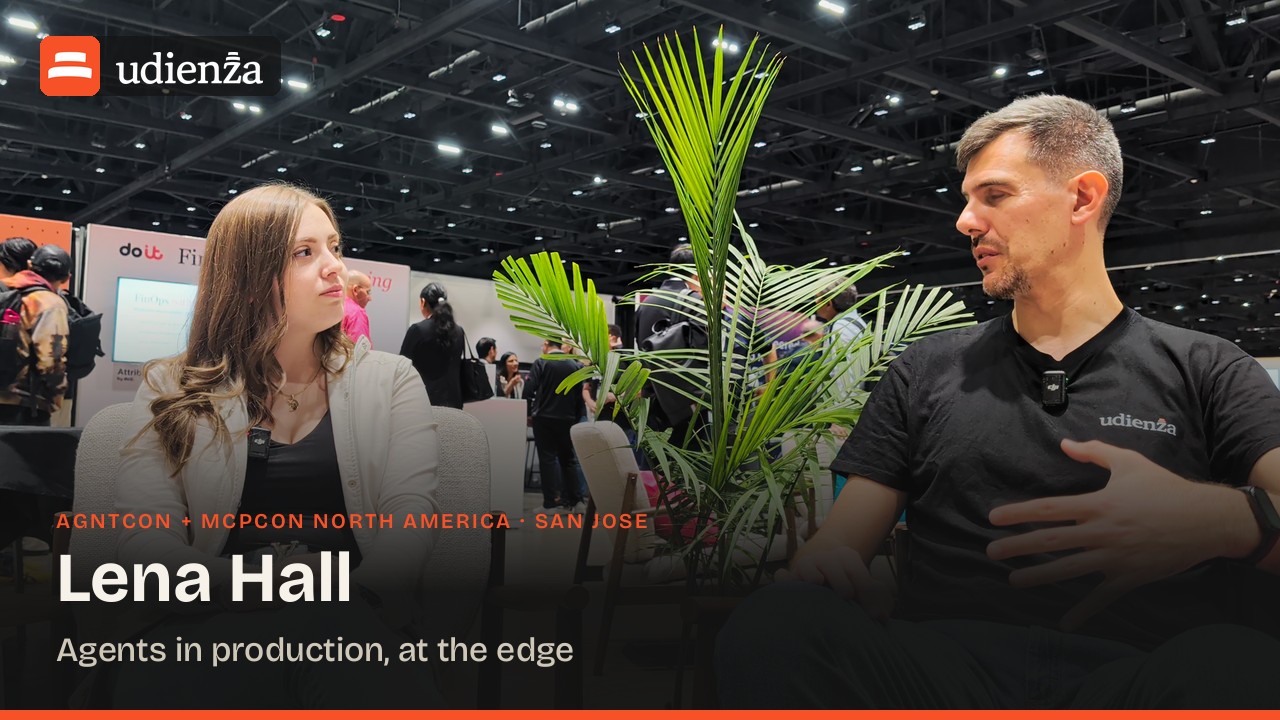
Lena Hall is Senior Director of Developer Relations at Akamai, where she leads developer relations for Akamai Cloud. Luca Berton talked to her at AGNTCon + MCPCon North America 2026 in San Jose on 22 October 2026. Her subject was what changes when an agent leaves the demo and has to work for real customers.
Why distributed infrastructure
Developers have worked with AI for years, she says, and as agents get more powerful, what people build with them gets more complicated. Akamai Cloud’s distributed infrastructure is there to give them “a powerful, fast, effective, and secure environment” for it.
One of the biggest use cases she sees is autonomous operations, in retail, banking or health care. In shopping, an agent can recommend products from a customer’s history and preferences. The shopper spends less time choosing, the business runs more efficiently, and the path “from exploration to purchase” gets shorter.
A demo forgives things
Most demos are “a Hello World agent” on one of the frontier models from a centralised provider, and for simple scenarios that works perfectly well. A demo forgives things: nobody asks how much downtime is acceptable, or whether an operation completes within so many milliseconds. “For production, you need to account for scale, security, distribution and latency in a way that matters for your customers.”
Her example is a customer support agent that talks to people through a multimodal voice API. If the delay in its speech is too long, people simply cancel the call. The agent has to “operate at the latency and at the cost that is sustainable”.
Control means locality
Many of Akamai’s customers want more control over their infrastructure in production, and control, for her, means locality. Some data cannot leave a place: a robot in a warehouse where unreleased products are stored has to keep its data in one geography, in a confined environment. And a request should be routed to the model and the compute closest to the user, for the best latency. Open-weight models make both possible, because they can be fine-tuned and optimised for a location and keep the data there. Luca noted how much this matters in Europe, where data sovereignty is a big discussion.
What Akamai offers
GPUs are hard to get right now, she says. Akamai provides AI infrastructure on NVIDIA GPUs, Blackwell among them, to build agents and run inference on. Open-weight models can be deployed and fine-tuned on Akamai Cloud, so the customer keeps control of location, data and latency.
There are serverless functions too, similar to AWS Lambda, but without its usual problem: the first request waits for a cold start. Akamai’s functions are based on Spin, a CNCF project based on WASM, which “basically eliminates cold starts”. A function that starts at once, with the model routed by where the user is, improves latency significantly.
Where to start
Her starting point is github.com/akamai-developers, with workshops on AI inference, on deploying and optimising open-weight models and on routing requests. Akamai’s Discord community, the Edge Case, talks about LLMs, serverless and cloud computing, with live-coding shows.
Her advice: pick a quick start or a workshop, think of a real problem from your own life, and build it with a coding agent, keeping in mind the constraints you will meet in production as you scale. And think about security, because agents can perform dangerous operations: “make sure you use sandboxing and safe environments”.
More
The episode with Lena Hall is being produced and goes out on YouTube first. The day it was recorded: AGNTCon + MCPCon North America 2026: day one.
Built something the rest of us run on? Being a guest is free. Take the other chair
The episodes in this article
All episodes →-
Episode 63 · Coming
Lena Hall: Agents in production, at the edge