3 min read
Quesma: what agentic coding is really worth
Jacek Migdał, founder of Quesma, on collecting agent session logs to coach prompting, tune the setup and attribute AI spend, and why savings get reinvested.
By  Luca Berton
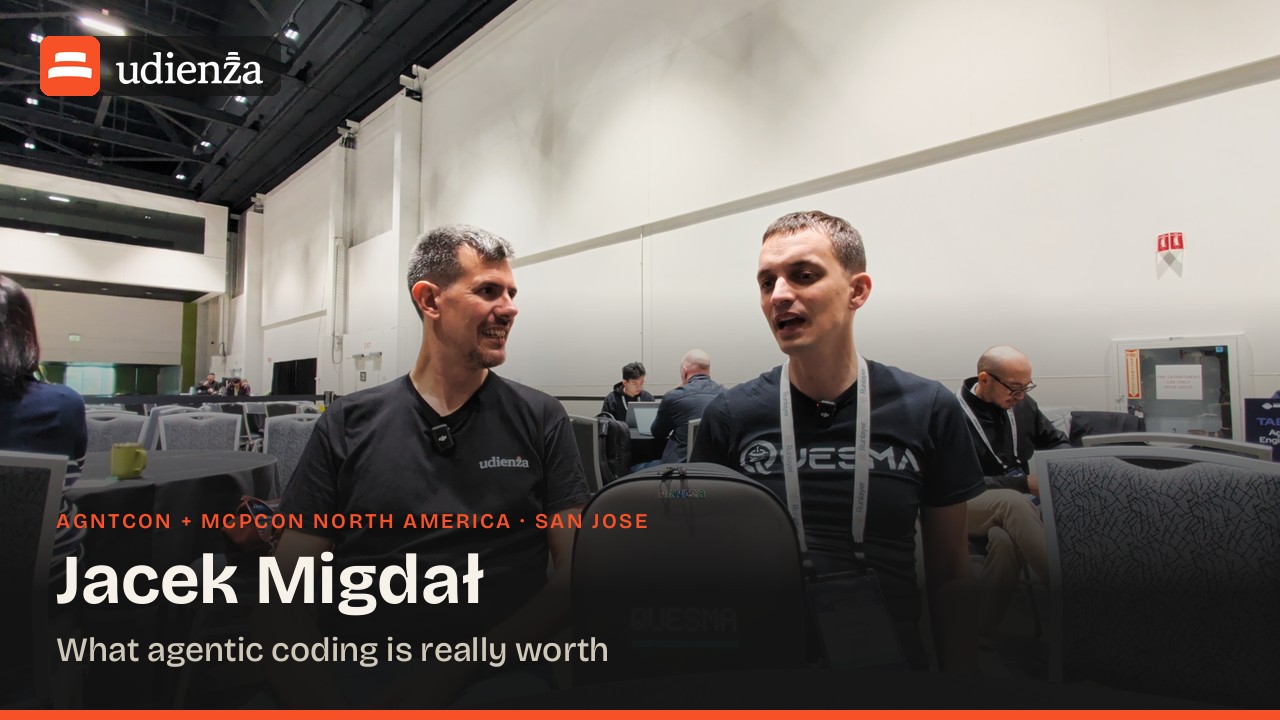
Jacek Migdał is the founder of Quesma. Luca Berton talked to him at the Quesma booth at AGNTCon + MCPCon North America 2026 in San Jose on 23 October 2026. “We try to maximize the economical value of agentic coding,” he says. Writing software is one of the biggest uses of the labs’ models, and it is very hard to measure; Quesma helps companies get the best value out of it.
The booth had its own demo: a backpack with a screen, bought from China. The hardware was nice, the software not so user-friendly, so the team used Claude Code to reverse engineer it and turn it into Quesma’s merchandise.
Session logs
Quesma collects agentic session logs: “anytime agent takes any actions, we collect that data.” The collection is open source, so people can simply archive their logs. Once collected, the data is scrubbed of credentials and private details and encrypted, and Quesma analyses it with other LLMs to find insights and possible improvements, or just to understand what is going on.
Three kinds of value
The first is coaching a team in effective prompting. Many people ask an agent twenty times for something they could get in one, if they defined the final goal better.
The second is the setup. With the right data and design guidelines in place, agents do a much better job: they work faster and use fewer tokens, which means less waiting for people and fewer problems along the way.
The third is attributing the spend, to departments and cost centres, for the budget or for managing subscriptions. “Should you be allowed to spend $1,000 per month or $100?” That can depend on what you are working on, and what the business gets out of it.
On every laptop
Luca asked whether it is an MCP server. The usual installation goes through the company’s device management onto every laptop, where a small program watches for new session logs, in JSONL files, and uploads them. It covers the harnesses from Claude Code to Codex.
Collecting and archiving is open source and free forever, and so is the product for individuals. Companies and enterprises get a free pilot. They can run it themselves, but so far Quesma has had the most success helping them through it.
Luca raised Europe’s concern with sovereignty. The open source design allows a mode in your own cloud, with your own key, and an on-premises version is mostly for bigger companies with the resources for it. “I believe this is the data that you should own,” Jacek says, because using AI also says something about how a company talks: “it’s kind of like the way how the company thinks.”
Where the savings go
The earliest adopters of agentic coding are still software companies, and it makes sense from five to ten people up, wherever the budget is a concern. A startup burning money may not care yet.
The savings can be large. In a new area there are many inefficiencies, and optimising the setup can cut the spend by about half. But most customers don’t keep the money. AI had limited what they could do, and as it gets cheaper they use it in new areas and get more done. “You take pictures cheaper, so you take more of them”: a Jevons paradox.
Quesma also publishes benchmarks on its blog, and several of them have reached the top of Hacker News.
More
The episode with Jacek Migdał is being produced and goes out on YouTube first. The day it was recorded: AGNTCon + MCPCon North America 2026: day two.
Built something the rest of us run on? Being a guest is free. Take the other chair
The episodes in this article
All episodes →-
Episode 71 · Coming
Jacek Migdał: What agentic coding is really worth