
5 min read
Red Hat Summit 2026: the stage and the floor
Atlanta in May: agents arriving inside the platform, zero trust workload identity, and practitioners on the floor describing a much older set of problems.
By  Luca Berton
Atlanta, 11 to 13 May
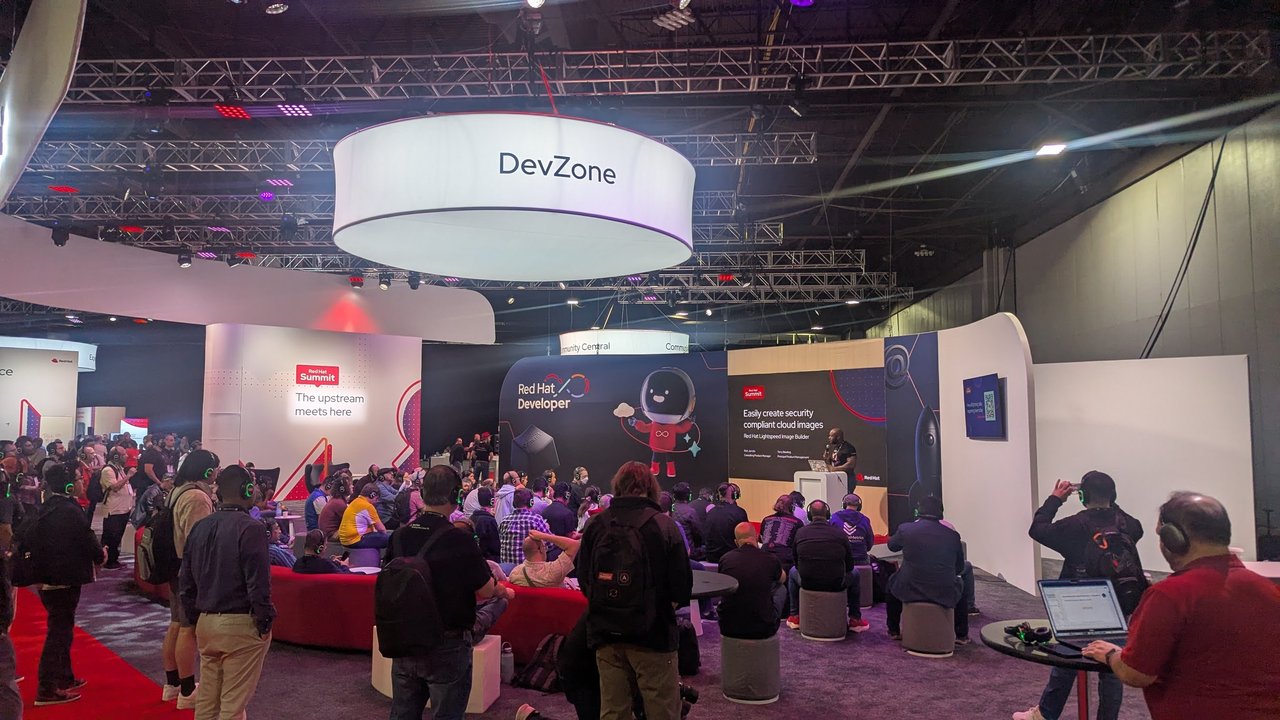
Red Hat Summit 2026 ran in Atlanta in May. The show recorded no episodes there, but the host, Luca Berton, was on the programme: a session in Discovery Theater 1 on multi-tenant GPU platform engineering. This is the part of the week worth keeping — what the keynote stage promised, and what practitioners standing in the hall said about their own clusters a few metres away.
The keynote: metal, agents and tokens
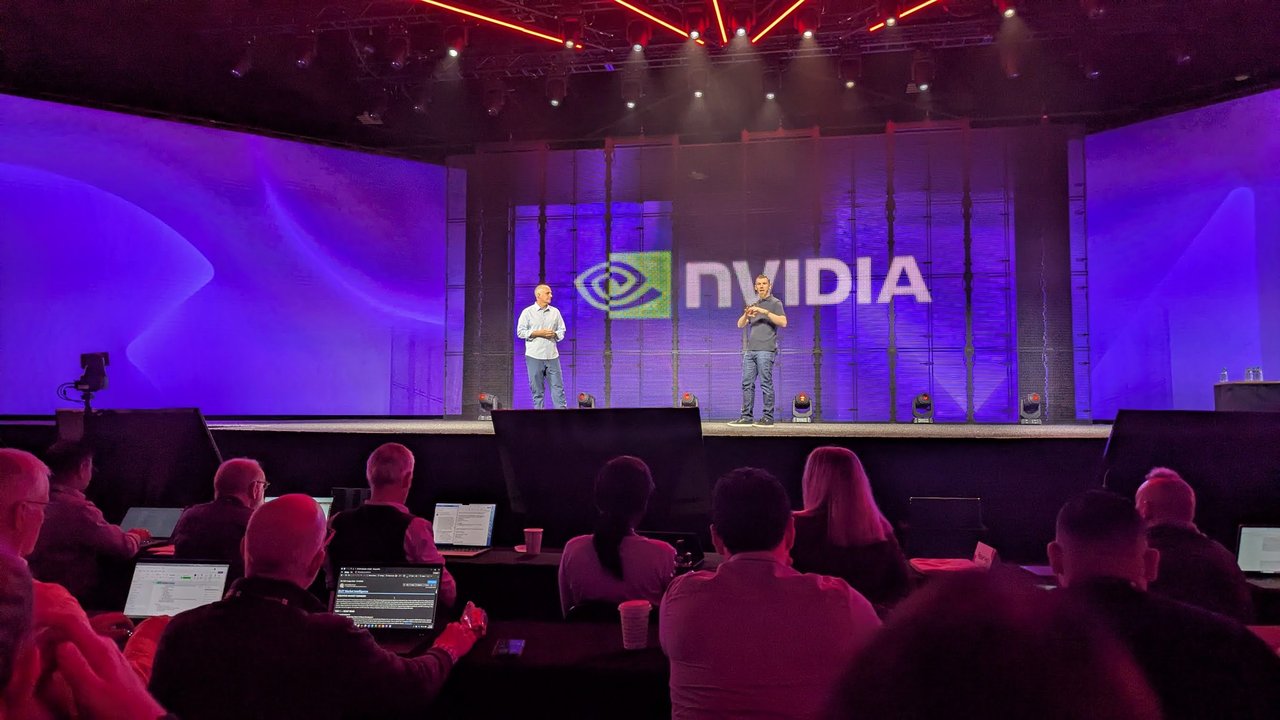
Matt Hicks opened. NASA appeared on the keynote stage, and so did NVIDIA, for the part of the story where the infrastructure argument becomes a GPU argument.
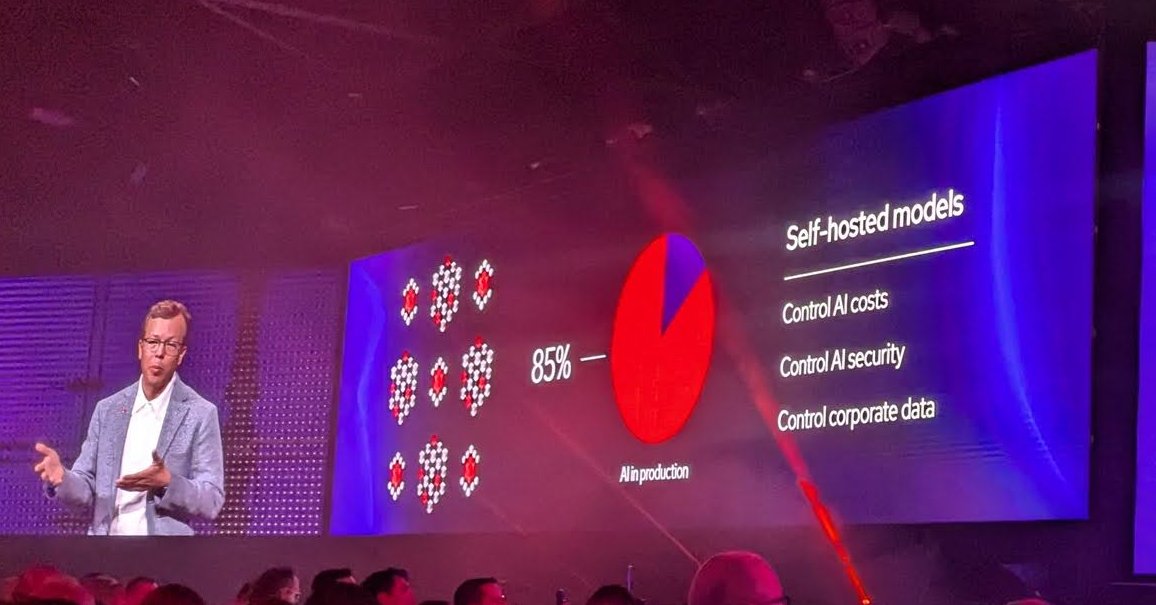
The slide that did the most work was about self-hosting. Against a figure of 85% for AI in production, the argument for running your own models came down to three things: control AI costs, control AI security, control corporate data.
Around it came the announcements: Fedora Hummingbird, a minimal immutable Fedora built entirely on bootc and image-based delivery; Red Hat Desktop, built on the Red Hat build of Podman Desktop with the open source Kaiden agent platform beside it, which is plainly an enterprise answer to Docker Desktop; Red Hat Hardened Images, base images shipped with CIS benchmarks applied and the attack surface cut; and OpenShell, an AI terminal built with NVIDIA.
Day two: the platform grows agents
The second keynote was the interesting one for anyone who runs clusters. On AI workloads it listed distributed inference with llm-d, scaling with LeaderWorkerSet, specialised hardware through dynamic resource allocation, and more efficient request routing — all presented as already in OpenShift. On virtualisation it opened with a show of hands about the price of server RAM, which got a laugh of the wrong kind, and answered with memory overcommit handled differently for VMs and containers, plus cross-cluster live migration.
Then security, and a slide that connects this week to several others.
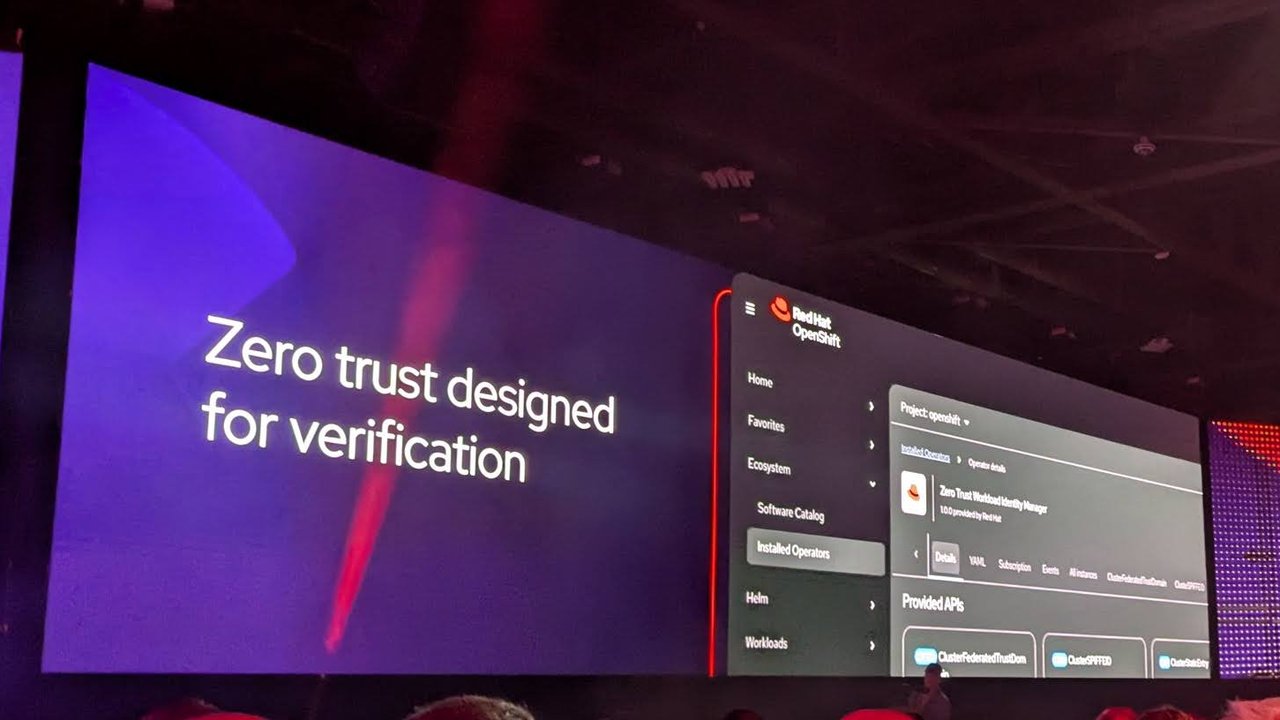
The argument was that nothing entering the network can be trusted — human, machine or agent — and the answer on screen is SPIFFE identity shipped as an operator. Five months later, at Nordic APIs Summit in Stockholm, the same problem arrived from the opposite direction: an authorisation server verifying an agent that has never registered. Infrastructure and API people are converging on workload identity from two sides and mostly not reading each other’s conference write-ups.
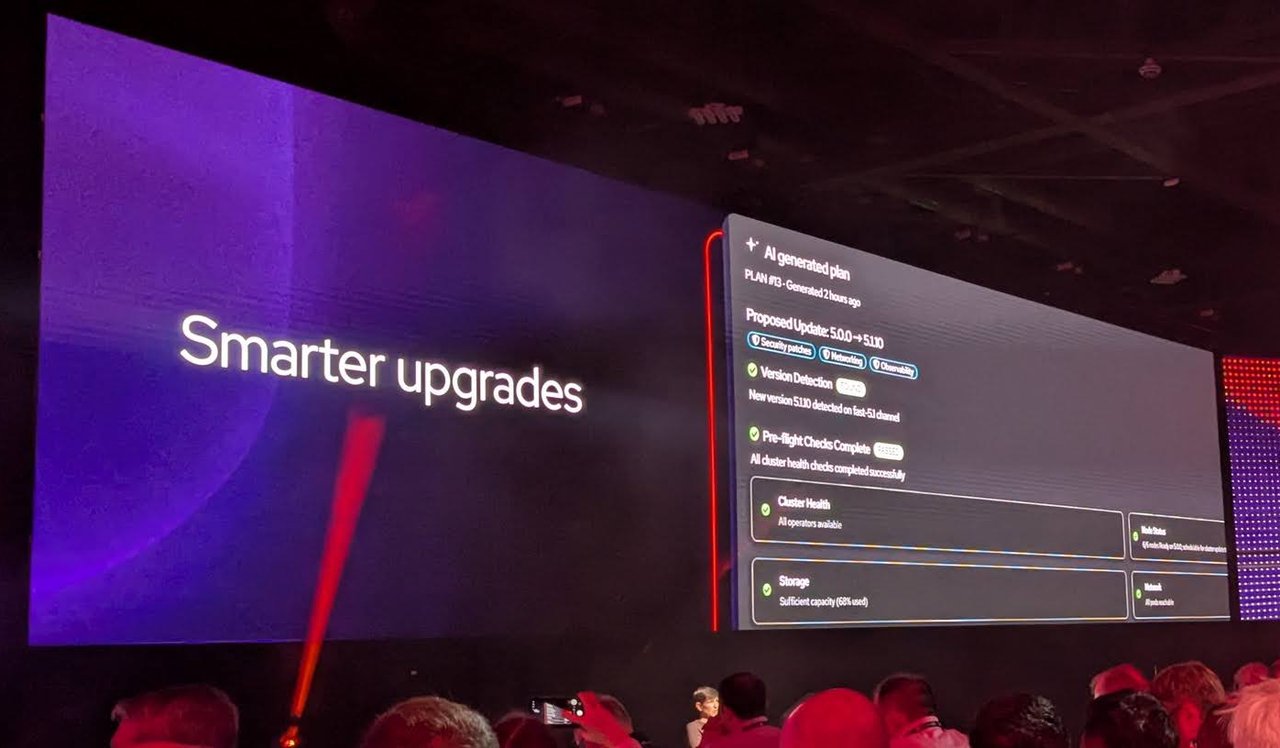
The last segment put agents inside the platform rather than on top of it. Red Hat is building agent skills and MCP servers so OpenShift is reachable by agentic workflows, and said those agents will ship in the product: triaging alerts with suggested remediation, spotting vulnerabilities in running workloads, and producing an upgrade plan.
Partner day: sovereignty, framed
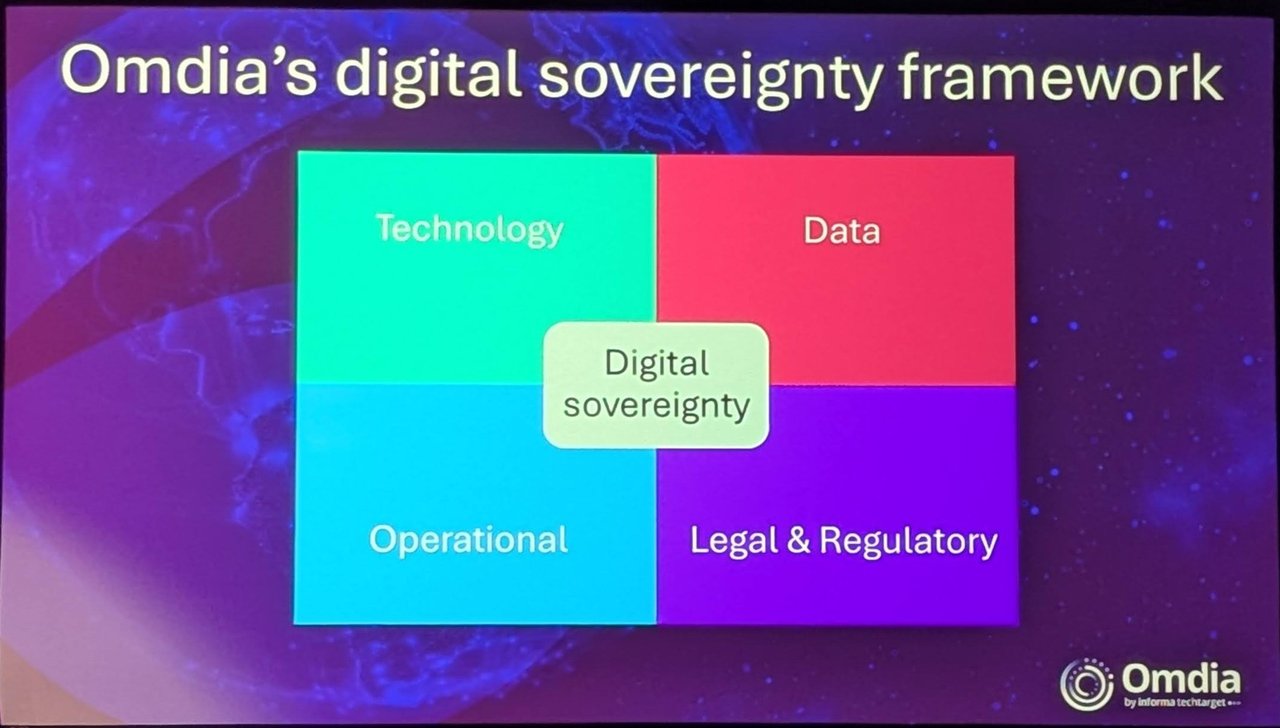
Partner day brought Omdia’s analyst framing, which is a cleaner statement of the thing every European infrastructure conference argues about: sovereignty is four questions, not one.
What the floor said
The reason to write this up is the gap. While the stage described agents that review your cluster, the conversations in the hall were about problems from a decade earlier, and the host collected thirteen of them.
One person running all of Kubernetes, with no second pair of hands and no runbooks. Clusters several minor versions behind, still in production, unsupported. Deployment templates predating the APIs everyone now assumes. Releases shipped by hand with oc apply, with no pipeline at all.
None of that is solved by an agent that drafts an upgrade plan. It is the same gap this show keeps finding: the platform work has to exist before anything can be automated on top of it, and AI raises the cost of not having done it.
The host’s own session
The talk in Discovery Theater 1 was about sharing GPUs between tenants on bare-metal OpenShift AI: open kernel modules and DMA-BUF, making contention deterministic so that fairness is a property of the scheduler rather than of who shouts loudest, and GitOps bootstrap bundles so a new tenant arrives as a reviewed commit. Its one-line summary doubles as the thread of the week — without quotas, isolation and visibility, the loudest workload wins.
Where to read more
The host’s notes on lucaberton.com, by day and by theme:
- The day one keynote and the eight announcements.
- The day two keynote: OpenShift, Ansible and agents.
- 13 things I heard at Red Hat Summit, the floor version.
- GPUs take flight, the host’s session.
- Meeting Chris Wright, Red Hat’s CTO.
- Partner day: Red Hat Desktop, Kaiden and the Omdia data.
- Floor chats: user groups, Coder and RISC-V.
Next
New episodes every Tuesday, on YouTube first, then Apple Podcasts, Spotify and Amazon Music; every platform is listed on the home page.
Built something the rest of us run on? Being a guest is free: how it works.
Built something the rest of us run on? Being a guest is free. Take the other chair